How Do You File an MTA Notice of Claim in New York?
To file an MTA notice of claim in New York, you must act within 90 days of your injury. Serve a sworn, written notice on the correct MTA agency. The notice must name you, describe the claim, and state the time, place, and manner of the accident. Without it, you cannot sue the MTA.
The Metropolitan Transportation Authority (MTA) runs the city’s subways, city buses, and commuter rail. That makes MTA injury claims different, and a notice of claim is a legal prerequisite to any lawsuit.
Many injured victims learn this too late, and one wrong recipient or missed day can end your claim. The same rules also apply if an MTA bus in the Bronx hit you.
At Uptown Injury Law, PLLC, our attorneys handle this step for you. We draft the notice and serve the right MTA entity, so you can focus on your recovery. Call 917-540-8728 for a free consultation.
Key Takeaways
- You have 90 days from the accident date to serve your MTA notice of claim.
- Serve the correct MTA entity, because a notice sent to the NYC Comptroller does not count.
- Swear to a written notice that states who you are, what happened, and when, where, and how.
- Deliver the notice in person or by registered or certified mail, and keep proof of delivery.
- Filing a notice does not start your lawsuit, so you must still sue within one year and 90 days.
What Steps Do You Take to File an MTA Notice of Claim?
To file an MTA notice of claim in New York, follow these five steps in order:
- Confirm the MTA entity that runs the bus, train, or station where you were hurt.
- Gather your name, address, accident details, and injuries.
- Write the notice and swear to it under oath.
- Serve it by personal delivery or registered or certified mail within 90 days.
- Keep your proof of delivery and track your lawsuit deadline.
Each step matters because the notice, a late notice petition, and the lawsuit run on separate deadlines. The table compares all three.
| Filing | Purpose | Deadline |
|---|---|---|
| Notice of claim | Tells the MTA about your injury and begins the claims process | Within 90 days after the accident |
| Late notice petition | Asks a judge for permission to serve your notice after those 90 days | Before the lawsuit deadline |
| Lawsuit | Asks a court to award you damages | Within 1 year and 90 days after the accident, or about 15 months |
Meeting one deadline does not satisfy the others, because each one runs separately. After you serve the notice, you must wait 30 days before you sue. The lawsuit clock keeps running during that wait, and wrongful death claims follow different timing rules. However, if more than 90 days have passed, ask an attorney about a late notice right away.
What Is an MTA Notice of Claim?
An MTA notice of claim is a formal written document that tells the MTA you were hurt and want compensation. You sign it under oath, and it describes who you are, what happened, and how you were injured. Public Authorities Law § 1276 bars an MTA lawsuit, including any tort claim, without timely notice. In addition, General Municipal Law § 50-e sets the content rules.
The notice also gives the MTA the right to investigate while evidence is fresh. Government entities use this claims process to review municipal claims and other public entity cases. Because the filing procedure differs by agency, meeting this claim requirement for the right agency matters. Our attorneys check each notice against these rules before we serve it.
Who Can File an MTA Injury Claim?
Anyone injured by an MTA vehicle, station, or property can file an MTA injury claim. In fact, you do not need to be a passenger. Personal injury claims against the MTA commonly come from these people:
- Riders hurt on a bus, subway car, or commuter train
- Pedestrians struck by an MTA bus or train
- Cyclists and drivers hit by an MTA vehicle
- Families of a person killed by an MTA vehicle
In wrongful death cases, the 90 days run from the appointment of the estate’s representative. MTA employees hurt on the job generally rely on workers’ compensation instead, because General Municipal Law § 50-e excludes those claims.
Common MTA accidents include a bus accident or a subway collision. For example, slip-and-fall accidents often happen in subway stations, on platforms and stairs, or inside a subway car. Likewise, a subway injury or a crash with city buses can lead to personal injury cases. Sudden stops can also cause a traumatic brain injury.
In 2022, the MTA reported 234 incidents of people struck by trains and 88 deaths, per FOX 5 NY. If a bus driver caused your injury, you still serve the MTA entity, not the driver. Also, the law does not require you to serve the employee separately. Overall, our bus accident attorneys identify every responsible party, including the driver’s employer.
How Long Do You Have for an MTA Notice of Claim?
You have 90 days from the incident date to serve your MTA notice of claim. Specifically, the clock starts on the day of the accident. For instance, the table counts forward from an accident on November 3, 2026.
| Milestone | Example Date |
|---|---|
| Accident | November 3, 2026 |
| Day 30 | December 3, 2026 |
| Day 60 | January 2, 2027 |
| Day 75 (safe target to serve) | January 17, 2027 |
| Day 90 (notice deadline) | February 1, 2027 |
| One year and 90 days (lawsuit deadline) | February 1, 2028 |
However, weekends and holidays can affect counting, so confirm your final date with an attorney. Mail service is complete when you deposit the notice, but day 75 is a safer target. The claim deadline is firm, and the deadline applies even while you are still treating. Meanwhile, we track each date from your first call.
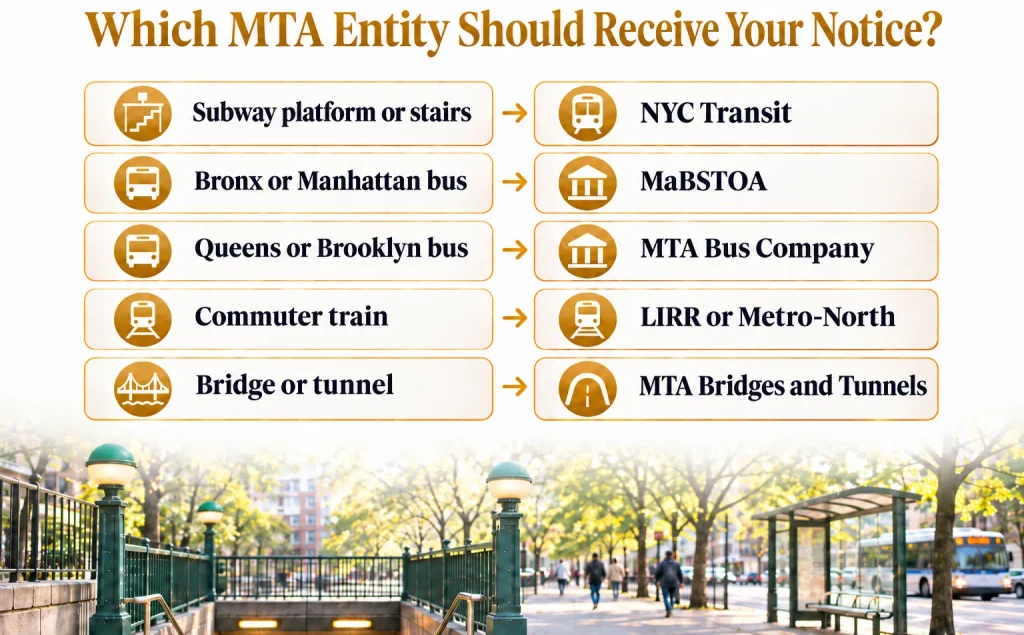
Which MTA Entity Should Receive Your Notice?
Serve the MTA entity that runs the bus, train, or station where you got hurt. The New York City Transit Authority is one such agency. Courts treat the MTA and its agencies as separate legal entities.
A notice sent to the wrong one can fail, even if it arrives on time. Therefore, naming the correct entity identifies the proper defendant and keeps the MTA accountable.
| MTA Entity | What It Runs | Common Injury Locations |
|---|---|---|
| NYC Transit | Subways and many local buses | Platforms, stairs, escalators, elevators, buses |
| MaBSTOA | Bus lines in Manhattan and the Bronx | Bus boarding, sudden stops, collisions |
| MTA Bus Company | Bus lines in Queens, Brooklyn, the Bronx, and Manhattan | Bus boarding, sudden stops, collisions |
| Staten Island Railway | Rail service on Staten Island | Stations and trains |
| Long Island Rail Road | Commuter rail on Long Island and into the city | Stations, platforms, and trains |
| Metro-North Railroad | Commuter rail north of the city | Stations, platforms, and trains |
| MTA Bridges and Tunnels | Toll bridges and tunnels in New York City | Crossings and toll plazas |
To identify the entity, note the bus number, route, car number, and station name. If the facts are unclear, we may serve multiple entities to protect your claim. In bus crashes, our attorneys also match the bus number to the correct operator. We confirm the right entity before serving anything.
The NYC Comptroller Does Not Accept MTA Claims
The NYC Comptroller’s Office does not accept claims against the MTA. It handles claims against the City instead. If a city vehicle hit you, read about claims against the City of New York.
Subway, LIRR, and Metro-North Claims Follow the Same 90-Day Rule
Public Authorities Law § 1276 says its service rule does not apply to a subsidiary corporation. However, that does not mean you can skip the notice. So serve within 90 days anyway, and confirm the rule for your agency with an attorney. Also, for New York City Transit, see Public Authorities Law § 1212.
Which Facts Should You Collect Before Writing the Notice?
Gather your identity details, the exact time and place, and your injuries before you write anything. This prevents gaps that the MTA can challenge later.
- Personal details: your full legal name, current address, and phone number
- Accident details: the date, approximate time, and exact location, such as the station, platform, stop, or cross streets
- Identifying details: the bus number, route, train line, or car number
- Injury details: every injury you know about, your providers, and your treatment dates
- Witness details: names and contact information for anyone who saw what happened
Next, write down your own account while it is fresh, using short dated notes. Also, if your child got hurt, tell an attorney right away. For instance, a court weighs a claimant’s age when it considers a late notice. We can gather most of these facts with you on a first call, including bus details from photos.

What Should Your MTA Notice of Claim Say?
You must put your notice in writing and swear to it, or have someone swear on your behalf. General Municipal Law § 50-e specifically lists what it must contain.
| Required Detail | What to Include | Example |
|---|---|---|
| Name and address | Your full name and mailing address, plus your attorney’s | Jane Doe, 123 Main St, Bronx, NY |
| Nature of the claim | A short statement of how the MTA’s conduct injured you | Injury from a fall on a hazardous stair |
| Time | The date and approximate time | November 3, 2026, about 6:40 p.m. |
| Place | The exact location, with cross streets, station, platform, or route | Southbound 4 train platform, Fordham Road station |
| Manner | A plain account of how it happened | I slipped on a wet stair with no warning sign |
| Injuries | The injuries you know about now | Broken wrist and head injury |
The statute asks for injuries “so far as then practicable.” So list what you know today, and add more later. Your attorney can also advise how to describe the damages claimed.
Compare two descriptions. A weak one says, “I fell at the station.” A strong one adds the date, time, platform, and wet stair. As a result, the strong version gives the MTA the time, place, and manner the statute requires.
Keep the notice factual. Also, do not guess about causes or admit fault. Avoid downplaying your pain, because the MTA can quote your notice later. Our attorneys draft the notice so each required detail is clear.
How Do You Serve the Notice and Prove Delivery?
Serve the notice by personal delivery or by registered or certified mail, then keep your proof.
- Sign the notice under oath, usually before a notary.
- Copy the signed notice for your records.
- Serve the person designated to receive a summons for that entity, or its regular attorney.
- Send it early, because mail service is complete once you deposit the notice at the post office.
- Keep your proof, such as the certified mail receipt, the return receipt, and the tracking record.
Meanwhile, protect your evidence. Learn about securing camera footage before the agency overwrites it. Finally, we handle service, keep the proof in your file, and confirm the notice was properly served.
Can a Wrong or Defective MTA Notice of Claim Be Fixed?
Often, yes. A good-faith mistake in your notice can usually be corrected. However, a notice sent to the wrong entity or served late is harder to fix.
| What Went Wrong | Can It Be Fixed? | What to Do |
|---|---|---|
| Mistake or omission in the content | Often, if made in good faith and the MTA suffered no prejudice | Ask an attorney to request a correction under General Municipal Law § 50-e(6) |
| Served on time but in the wrong manner | Possibly. The service stays valid unless the MTA returns the notice within 30 days and names the defect | If it returns the notice, serve a proper copy within 10 days |
| Sent to the wrong MTA entity | Harder. A court may weigh an excusable error about the entity | Act at once and apply before the lawsuit deadline |
| Missed the 90 days | Only with court permission | Petition for a late notice before the lawsuit deadline |
Keep every receipt, copy, and envelope, and speak with an attorney the same week. Because time matters, we review a defective notice quickly and move to correct it.
What if Injuries Keep You From Acting Early?
Treat the 90 days as running while you recover, and ask someone to start your notice early. The clock begins on the accident date rather than the day you leave the hospital.
A Trusted Person or Attorney Can Act for You
The statute lets the claimant or someone on the claimant’s behalf swear to the notice. A family member can gather records and details, and an attorney can draft, swear, and serve the notice. Also, keep a simple log of appointments and calls with the MTA.
A Late Notice Needs a Court Order
A court can allow a late notice under General Municipal Law § 50-e(5). A judge weighs several factors, including physical or mental incapacity and whether you have a reasonable excuse for the delay. The court also asks whether the MTA had actual knowledge within a reasonable time and whether the delay prejudiced it. You must apply before the lawsuit deadline passes, and approval is not guaranteed.
Late Notice Requests Go to the Supreme Court in Your County
You apply to the Supreme Court in a county where you could bring the lawsuit. Also, attach a copy of the proposed notice. New York City’s counties are:
- Bronx County (the Bronx)
- Kings County (Brooklyn)
- New York County (Manhattan)
- Queens County (Queens)
- Richmond County (Staten Island)
Because speed matters, our firm moves quickly when a client is in the hospital.
Do You Need a Lawyer for Your MTA Notice of Claim?
You can file the notice yourself, but technical mistakes are easy to make, so many injured people hire a lawyer. Personal injury lawyers know these strict rules, and legal representation helps you avoid a defective notice. An MTA personal injury claim needs a valid notice before you file suit. In fact, a personal injury lawsuit against the MTA depends on that notice.
Call a lawyer right away if your injuries are serious or you need surgery. Do the same if you do not know which MTA entity is responsible. Act quickly if the 90-day deadline is close or has passed, or if several parties may share fault.
Here is how our personal injury law firm handles your notice:
- First, we confirm the correct MTA entity.
- Next, we draft and swear the notice with every required detail.
- Then we serve it by an approved method and keep proof.
- We also request bus footage, bus driver records, and maintenance data.
- Finally, we track the MTA’s response and prepare you for any 50-h hearing.
For bus cases, our bus accident lawyers in New York also handle the related injury claim.
What Happens After You Serve the Notice?
After you serve the notice, the MTA investigates your claim and may ask to examine you under oath. It may also request a General Municipal Law § 50-h hearing, a sworn interview about the accident and your injuries. Still, serving the notice is only the first step. The claim deadline for suing is separate, and the deadline applies even while talks continue.
If you prove your case, you can recover two kinds of damages:
- Economic damages cover medical bills, other medical expenses, and lost wages.
- Non-economic damages cover pain and suffering and emotional distress.
You can recover compensation even if you were partially at fault. Under CPLR 1411, New York’s pure comparative negligence rule, the court reduces your award by your share of fault. We build your damages evidence while the claim is pending.
Our goal is fair compensation, and in serious cases full compensation. We review every settlement offer with you before you decide.
Talk to a New York MTA Accident Lawyer Today to Get a Free Case
Miss a deadline or serve the wrong entity, and an MTA injury claim can end before it starts. You should not have to learn these rules while you recover. A New York personal injury attorney who knows them can protect your claim deadline from day one. If a bus, subway car, or commuter train hurt you, our subway accident lawyers and bus accident attorneys can help.
Here is the experience behind your MTA case:
- Over 15 years of personal injury experience, led by senior trial lawyer Kyle Newman
- More than $100 million recovered for clients across the New York City area
- Attorney Client Satisfaction “10 Best” Award, 2021
- National Trial Lawyers Top 40 Under 40 recognition
Every case is different, and past results do not guarantee a similar outcome.
At Uptown Injury Law, we confirm the correct MTA entity, prepare your notice, and track your claim deadline. Also, your first call is a free consultation, so you can get answers before you commit.
Call 917-540-8728 or visit our office at 2417 Third Ave, Suite 505, Bronx, NY 10451. In addition, our Bronx personal injury lawyers serve injured people across the Bronx, Queens, Brooklyn, and nearby areas. You can also request a free case review online.
FAQs
Can I File the Notice Online?
Do not rely on online or email filing for an MTA claim. Instead, the statute lists personal delivery and registered or certified mail. It allows electronic service only in a form that a city of over one million people prescribes. That rule concerns City agencies, so confirm the method with an attorney first.
Does MTA Knowledge of My Accident Replace the Notice?
No, the MTA’s knowledge of your accident does not replace the notice. Rather, it is one factor a court weighs when you ask to serve a late notice. Serve the notice on time instead of relying on that factor.
Do I File Again for a Second Injury?
You file a new notice for a new accident, and it carries its own 90-day clock. However, new injuries from the same accident generally belong to your original claim. The notice lists injuries “so far as then practicable.” An attorney can advise whether to supplement it.
Do Visitors Hurt on an MTA Train Need a Notice?
Yes, visitors need a notice too. The requirement applies to the claim against the MTA rather than to where you live. A tourist hurt on a subway platform follows the same 90-day rule. Confirm your situation with an attorney if you live outside New York.
Do I Need to Attach Photos or Medical Records?
The statute does not list attachments as a requirement. Include the required details, such as your name, the time, place, and manner, and your injuries. Keep your photos and medical records ready for later. Still, your attorney can use them if the MTA requests more information.