What Are New York Car Accident Laws in 2026?
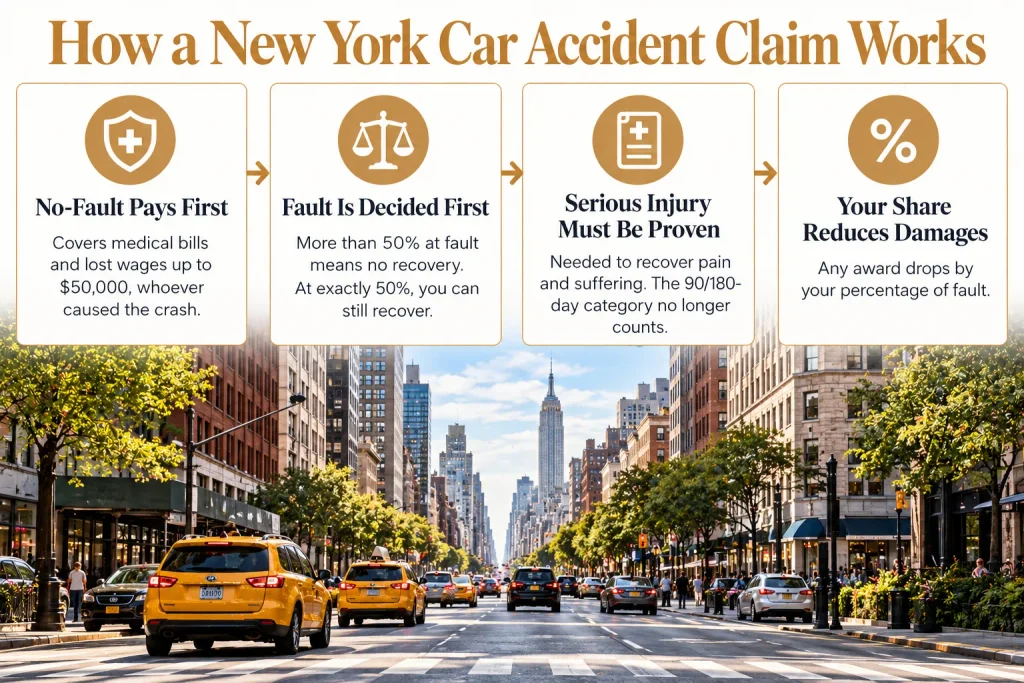
New York car accident laws combine no-fault insurance, a serious injury threshold, and fault rules. For lawsuits filed on or after May 26, 2026, you cannot recover if you are more than 50% at fault, and the 90/180-day injury category no longer counts. You must file most injury lawsuits within three years.
These rules matter when a car crash in the Bronx, Brooklyn, Queens, Manhattan, or Staten Island leaves car accident victims like you with medical bills and missed work. You are far from alone, since NYC DOT counted 47,557 traffic injuries through December 15, 2025. The stakes are higher now because, in 2026, New York changed what damages you can recover.
Car accident lawsuits also come with strict time limits, and most start on the date of the accident. Insurance companies know these rules, and they count on you not to. Our attorneys at Uptown Injury Law, PLLC, fight for the full compensation New York car accident laws allow, prove your injuries meet the serious injury threshold, and file before your deadline expires. Call 917-540-8728 now for a free case review.
Key Takeaways
- New York car accident laws now use modified comparative negligence if you file suit on or after May 26, 2026.
- You cannot recover if your fault exceeds 50%.
- No-fault insurance covers up to $50,000 per person if you file within 30 days of the accident.
- To sue for pain and suffering damages, your injuries must meet the serious injury threshold in Insurance Law Section 5102(d).
- You can no longer use the 90/180-day serious injury category.
- A $100,000 cap on non-economic damages applies only to certain at-fault drivers.
What Changed in New York Car Accident Laws in 2026?
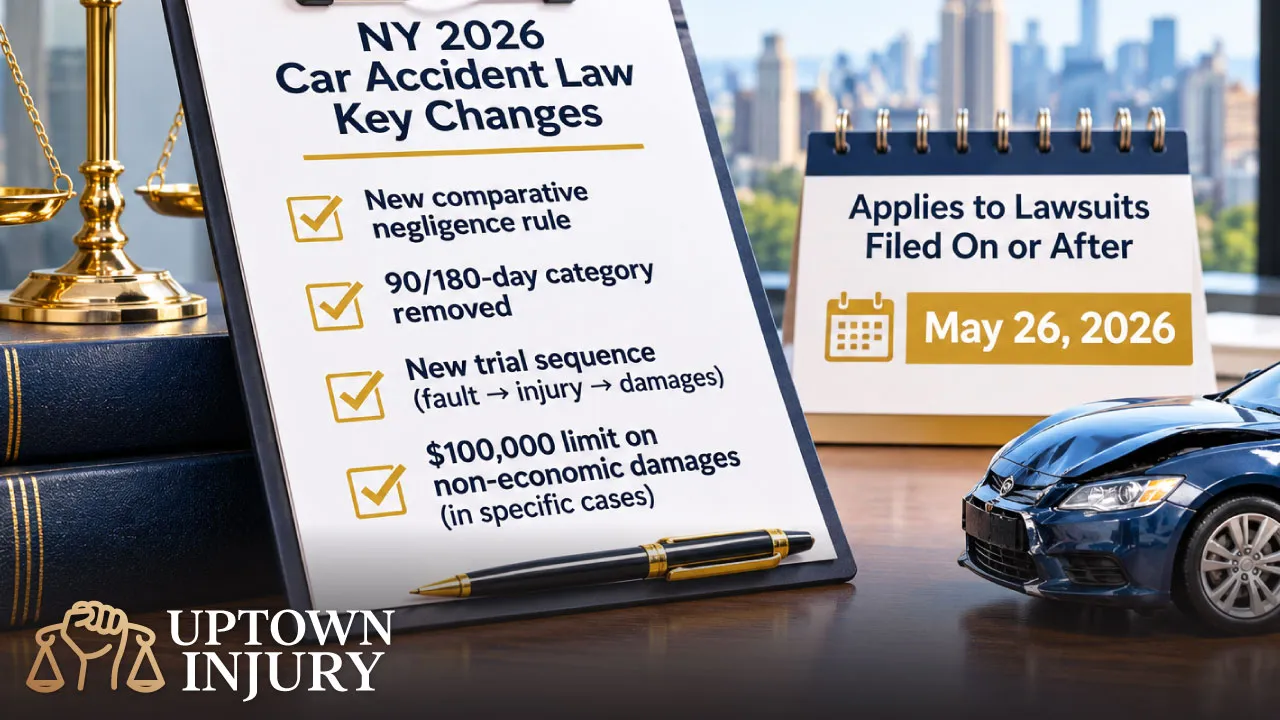
New York car accident laws changed in four ways in 2026. The new law was included in the state budget (Part EE of the FY2027 budget), so it applies to lawsuits filed on or after May 26, 2026.
Together, these changes decide whether you can recover and how much. Here is each change, what it means for you, and the law behind it:
| Change | What it means for you | Law |
|---|---|---|
| 50% fault bar | In a motor-vehicle injury case, you recover nothing if you are more than 50% at fault. At exactly 50/50, you can still recover. | CPLR 1411(b) |
| Serious injury | The 90/180-day category no longer counts as a serious injury. | Ins. Law 5102(d) |
| Fault-first trials | A jury decides fault first, then serious injury, then damages. | Ins. Law 5104(a) |
| $100,000 cap | The law caps pain and suffering for some at-fault uninsured drivers, convicted impaired drivers, or convicted felony drivers. | Ins. Law 5104(d) |
If your crash happened before May 26 and you have not filed yet, the new rules can still apply. So the date you file, or plan to file, determines whether the 2026 law applies to your crash. However, two things did not change. No-fault benefits remained unchanged, and a proposal to change joint and several liability did not pass.
Apart from those four rules, New York’s staged-accident fraud law expanded the definition of fraudulent insurance acts to include staging motor-vehicle accidents. The Department of Financial Services says the law now also allows prosecutors to seek criminal penalties for insurance fraud against any individual who organizes a staged accident.
How Soon Must I Report a Car Crash in New York?
The deadline for reporting a car accident in NY to the DMV is 10 days if anyone was hurt or killed, or if property damage totaled $1,000 or more. In those cases, you must file Form MV-104.
Under Vehicle and Traffic Law 605, those 10 days run from the day of the crash, so do not wait for a lawyer, an insurer, or a police report before you file.
Instead, build your report at the scene. Call 911 if anyone needs help and get medical care as soon as you can. Also, if it is safe, write down or photograph these details:
- The date, time, and exact location of the crash
- The other driver’s name, license plate, and insurance information
- Names and phone numbers of any witnesses
- Damage to every vehicle and any road hazards
Afterward, ask the officer how to get a copy of the police report. In New York City, you can request it from the NYPD precinct where the crash happened for up to 30 days, using form PD 301-165. After that, the report comes from the DMV on form MV-198C.
Even if the police do not arrive at the scene, the 10-day DMV deadline still applies. Our car accident lawyers can request the report, check it for errors, and help you meet that deadline while you focus on treatment.
Important Note: Once you have filed with the New York State DMV, submit your no-fault application within 30 days of the accident, or you may risk a denial.
Does No-Fault Insurance Pay First in New York?
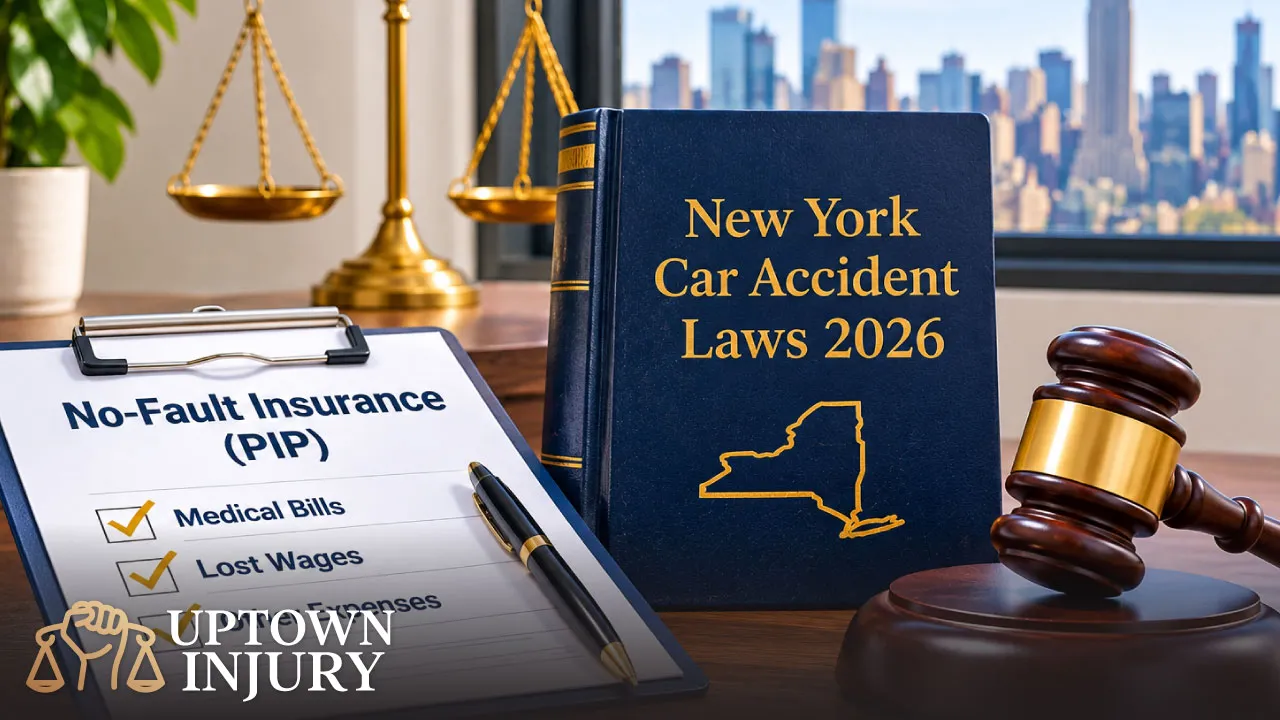
Yes, New York car accident laws require no-fault insurance to cover your initial medical bills, regardless of who caused the crash. In other words, New York is a no-fault state.
That coverage comes from Personal Injury Protection (PIP) under the no-fault insurance system, and it works like this:
- Limit: no-fault insurance covers you for up to $50,000.
- Benefits: PIP handles your medical expenses and reimburses 80% of lost earnings, up to $2,000 monthly for as long as three years.
- Other expenses: you can claim up to $25 a day for up to one year, plus a $2,000 death benefit.
- Other deadlines: submit your medical bills within 45 days and send proof of your lost wages within 90 days.
- Not covered: injuries you suffer as a motorcycle operator or passenger, and damage to your car.
However, the no-fault system does not pay you for pain and suffering. You can seek compensation for it only through a lawsuit, and only with a serious injury. Our car accident lawyers file your PIP claim, prove your injury qualifies, and sue for pain and suffering.
Do New York Car Accident Laws Require a Serious Injury to Sue?
Yes, to file a third-party personal injury lawsuit against the at-fault driver in New York, your injuries must still meet the serious injury threshold. What counts as a serious injury depends on state law, so a sprain or bruise that heals fully may not qualify.
Insurance Law Section 5102(d) sets that definition, and Insurance Law 5104(a) applies it. To qualify, your injury must fall into one of these eight categories:
- Death
- Dismemberment
- Significant disfigurement
- Fracture
- Loss of a fetus
- Permanent loss of use of a body organ, member, function or system
- Permanent consequential limitation of use of a body organ or member
- Significant limitation of use of a body function or system
Of these, a fracture qualifies on its own. But soft tissue injuries qualify only if they fit a category, such as significant limitation of use.
A medically determined injury of a non-permanent nature no longer qualifies, even if it stops the injured person from performing all material acts of that person’s usual daily activities substantially.
So keep all records of your medical treatment. A gap in care can weaken your medical evidence and put your pain and suffering compensation at risk. Our car accident lawyers then gather those records and document how the injury limits your daily life. They also challenge the insurer when it calls your injury minor.
What If I’m More Than 50% at Fault in a New York Car Accident?
Under the New York comparative fault rule, you cannot recover compensation for your car accident injuries if you are more than 50% at fault. New York car accident laws now use this modified comparative negligence system under CPLR 1411(b). The 2026 reform also excludes wrongful death cases from that system.
The jury compares your share of the blame to everyone else’s. So if more than one driver caused the crash, it weighs your share against their combined fault.
Here is how shared fault works if you are partially at fault:
| Your share of fault | What happens | You recover $200,000 in damages |
|---|---|---|
| 30% | You can recover, but the jury cuts your compensation by 30%. | $140,000 |
| 40% | You can recover, but the jury cuts your compensation by 40%. | $120,000 |
| 50% | You can still recover, because a 50/50 split does not bar your claim. | $100,000 |
| 51% | You recover nothing, because you are more than 50% at fault. | $0 |
Before the change, CPLR 1411 allowed injured drivers, crash victims, and other injured parties to recover even if they were 70% at fault. Now crossing 50% costs you your entire claim, so proving what happened matters more than ever. An attorney can challenge the insurer’s fault percentage, because even a few points can decide whether you recover anything.
What Is a Fault-First Trial Under New York Car Accident Laws?
In a fault-first trial, the jury decides who caused your car accident before it considers your injuries. Insurance Law 5104(a) now sets the order:
- Fault: who caused the crash, and how much each side is to blame.
- Serious injury: whether your injury meets the legal definition.
- Damages: how much compensation you should receive.
This order matters because of the 50% bar: if the jury finds you more than 50% at fault, it never reaches your injuries. So the fault case comes first, and a lawyer builds it from the police report, witness statements, and any traffic camera footage.
Does the $100,000 Pain and Suffering Cap Apply to My Car Accident Claim?
Only if you caused the crash and fit one of three groups. The $100,000 pain-and-suffering cap limits non-economic damages for certain at-fault drivers under New York car accident laws. UnderInsurance Law 5104(d), it applies to a driver who was:
- Uninsured: operating a vehicle they were responsible for insuring. The law exempts a lapse of less than 30 days, such as a 29-day insurance lapse.
- Convicted of impaired driving.
- Convicted of a felony committed while driving or fleeing.
The last two groups require a conviction, so a charge alone does not trigger the cap.
If you fit one of these groups, you can still file your car accident claim and recover non-economic damages, such as pain and suffering, but the law caps them at $100,000. Also, the 2026 auto law leaves economic losses, such as medical bills and lost wages, uncapped and excludes cases involving a death.
But if you were not at fault, the cap never applies to you. If an insurer says the cap applies anyway, a lawyer can check your insurance history, any charges, and the police report to confirm it.
What Are the Deadlines Under New York Car Accident Laws?
Deadlines under New York car accident laws range from 10 days to report your crash to three years to sue. Missing one can limit or end your car accident claim. Here are the main ones:
| What you need to do | Time limit | Source |
|---|---|---|
| File the DMV crash report (MV-104) | 10 days | NY DMV |
| File your no-fault application | 30 days | NY DFS No-Fault FAQs |
| File a notice of claim against New York City | 90 days | General Municipal Law 50-e |
| Sue New York City | 1 year and 90 days | General Municipal Law 50-i |
| File a car accident injury lawsuit | 3 years | CPLR 214 |
| File a wrongful death lawsuit | 2 years from the death | EPTL 5-4.1 |
Claims against the city, however, work differently if your crash involved a city vehicle, such as an NYPD car. You must file a notice of claim with the NYC Comptroller, and the city may require a hearing before you can sue. A lawyer can also prepare the notice and attend the hearing.
The lawsuit deadline carries the highest stakes, so know how long you have to file. Most car accident injury claims fall under New York law’s three-year statute of limitations in CPLR 214, and you must file in court, such as the New York Supreme Court, before it passes.
But if you lost a loved one in a crash, the deadline is shorter, so speak with a wrongful death lawyer soon.
If the other driver fled or had no insurance, the Motor Vehicle Accident Indemnification Corporation (MVAIC) may provide benefits. But you must file a police report within 24 hours. Then you have 90 days to file a Notice of Intention after a hit-and-run, or 180 days if you can identify the uninsured driver. You must also meet MVAIC’s eligibility rules.
How Much Insurance Do New York Car Accident Laws Require?
New York drivers must carry minimum liability coverage of $25,000 per person and $50,000 per accident for bodily injury, plus $10,000 for property damage. The NY DFS minimum coverage rules also require $50,000 in no-fault coverage and uninsured motorist coverage of $25,000 per person and $50,000 per accident.
| Coverage | Minimum required |
|---|---|
| Bodily injury liability | $25,000 per person, $50,000 per accident |
| Property damage liability | $10,000 |
| No-fault (personal injury protection) | $50,000 per person |
| Uninsured motorist | $25,000 per person, $50,000 per accident |
Supplemental uninsured/underinsured motorist (SUM) coverage is optional, but it lets you buy more protection, up to your own bodily injury limits.
Still, these minimums may not cover the costs of a serious crash. If the at-fault driver’s insurance company carries only the minimum, your financial recovery may fall short of your losses. If the driver has no insurance at all, your own uninsured motorist coverage may still apply. Finally, check your policy’s declarations page to see what insurance coverage you have. A lawyer can then look for every other policy that may apply to your crash.
Insurance pricing rules also changed in 2026. As Insurance Journal reports, the state budget bars insurers from using occupation, homeownership status, education level, or ZIP code as the primary basis for setting auto insurance rates, with some exceptions.
Talk to Our New York Car Accident Lawyers Before the Insurer Blames You
The other driver’s insurer will look for ways to blame you, and under the 2026 rules, more than 50% fault can end your claim. Meanwhile, witnesses forget details, camera footage gets erased, and your filing deadline keeps running.
At Uptown Injury Law, our car accident lawyers stand between you and the insurer. We help injured clients understand how New York car accident laws apply, secure the video and records before they vanish, and seek fair compensation from the insurance company.
For 15+ years, we have recovered over $100 million for injured New Yorkers. When you call, you get a team recognized in the National Trial Lawyers Top 40 Under 40 and a 10 Best Attorney Client Satisfaction Award, and we treat every client like family.
Moreover, we represent accident victims across the Bronx, Manhattan, Queens, Brooklyn, Westchester, and Long Island, 24/7. Visit us at 2417 Third Ave, Suite 505, Bronx, NY 10451, or we can come to you at home or in the hospital.
Call 917-540-8728 now for your free case review. You pay nothing unless we win.
FAQs
How Does Fault Work in New York Car Accidents?
A jury decides fault first, and you recover nothing if you are more than 50% at fault. That rule applies to lawsuits filed on or after May 26, 2026. At 50% or less, you can recover damages, and your financial compensation drops by your share of the blame. No-fault benefits are different, because they pay no matter who caused the crash.
Is New York a Comparative Negligence State for Car Accidents?
Yes, but the rule is now modified for car accident cases. The jury still reduces your compensation by your share of fault, but for lawsuits filed on or after May 26, 2026, you recover nothing if you are more than 50% at fault. The bar does not apply to wrongful death cases.
How Long Do I Have to Sue After a Car Accident in New York?
You have three years from the crash to file most injury lawsuits under CPLR 214. For a wrongful death lawsuit, you have two years from the death. Claims against New York City need a notice of claim within 90 days and a lawsuit within one year and 90 days. Because city claims move faster, an attorney can help you protect both dates.
Does the 2026 Law Apply to My Car Accident?
Yes, if you file your lawsuit on or after May 26, 2026, even if your crash happened earlier. The filing date controls, not the crash date. Courts have not settled every question about older cases, so do not assume the old rules apply. If your crash was before May 26 and you have not filed, talk to a lawyer soon.
What Counts as a Serious Injury in a New York Car Accident Now?
A serious injury fits one of eight categories: death, dismemberment, significant disfigurement, fracture, loss of a fetus, permanent loss of use, permanent consequential limitation, or significant limitation of use. But the 90/180-day category no longer counts for lawsuits filed on or after May 26, 2026.