Who Pays for Car Accident Compensation in New York?
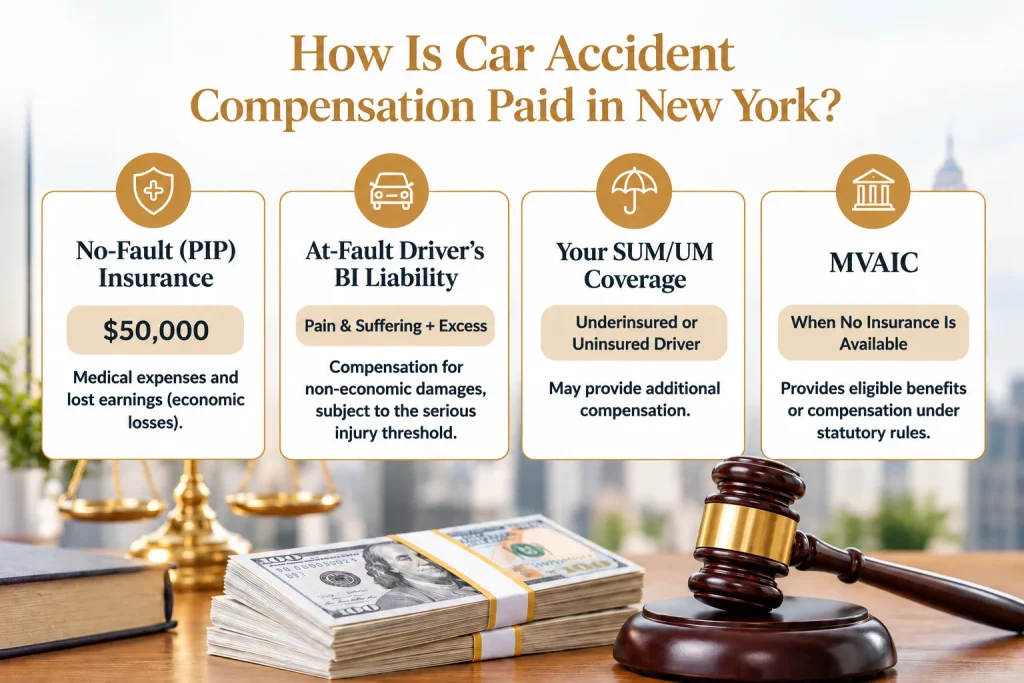
In New York, car accident compensation may come from your own PIP insurance, the at-fault driver’s liability coverage, or your SUM policy. The available compensation depends on insurance limits, evidence of negligence, and your losses. If you meet the serious injury threshold, you may also seek damages for pain and suffering.
However, determining who pays for your car accident injuries can be complicated. Insurance coverage, policy limits, exclusions, and the details of your accident can all affect your options. At Uptown Injury Law, PLLC, our car accident lawyer can review your case, identify available insurance coverage, and explain who may be responsible for your losses. Call 917-540-8728 for a free case review.
Key Takeaways
- New York is a no-fault state, so your PIP insurance generally pays first for eligible medical expenses and lost wages.
- Basic PIP coverage provides up to $50,000 per person under Insurance Law § 5102(a).
- The at-fault driver’s liability insurance may cover damages beyond your no-fault benefits.
- SUM coverage may provide additional compensation if the at-fault driver is uninsured or underinsured.
- MVAIC may help eligible accident victims without available auto insurance coverage.
- Your compensation may be reduced according to your percentage of fault under CPLR § 1411.
Who Pays for Injuries After a Car Accident in New York?
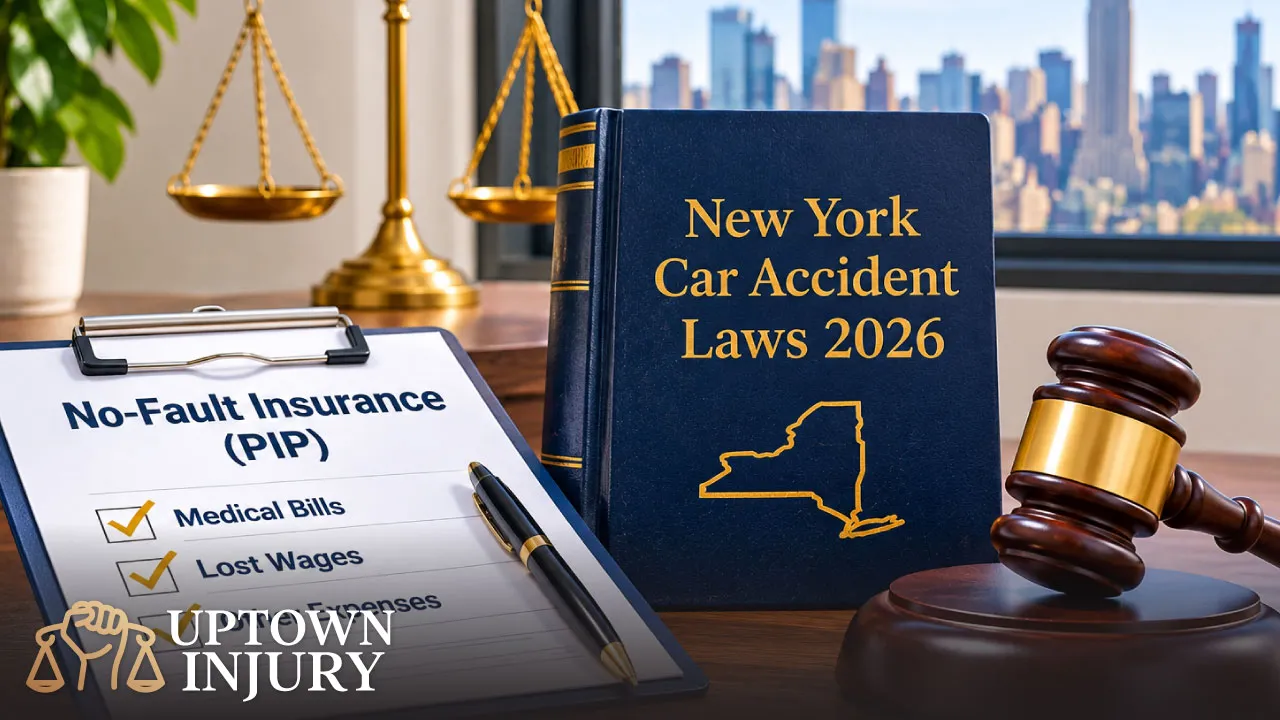
New York is a no-fault state, which means your own auto insurance generally pays first for eligible car accident injuries through Personal Injury Protection (PIP), regardless of who caused the crash. Under New York Insurance Law § 5102(a), basic no-fault coverage provides up to $50,000 per person for reasonable medical expenses, lost wages, and other necessary costs.
PIP also reimburses 80% of your lost wages, up to $2,000 per month, subject to applicable limits. To get these benefits, you generally must submit Form NF-2 to the insurance company within 30 days of the accident. No-fault coverage generally applies to eligible drivers, passengers, and pedestrians injured in a motor vehicle accident.
However, if another driver caused the accident, you may also pursue compensation through their liability insurance for losses that exceed your no-fault benefits. You cannot collect payment for the same expense twice from different insurance policies.
The compensation available to you depends on several factors, including:
Available Insurance Policy Limits
The amount of compensation you can recover depends partly on the insurance coverage available. New York requires drivers to carry at least minimum liability insurance, but some drivers carry higher policy limits.
If your damages exceed the at-fault driver’s available coverage, you may need to explore other options. These could include your own supplementary underinsured motorist (SUM) coverage or other applicable insurance benefits.
Evidence of Negligence
Evidence helps establish how the accident happened and whether another driver was legally responsible for your injuries. For example, police reports, witness statements, and photographs can help show who caused the collision.
You can also use traffic camera footage, dashcam recordings, and other accident evidence to support your insurance claim. Strong evidence can help establish liability and support your request for compensation.
Documented Losses
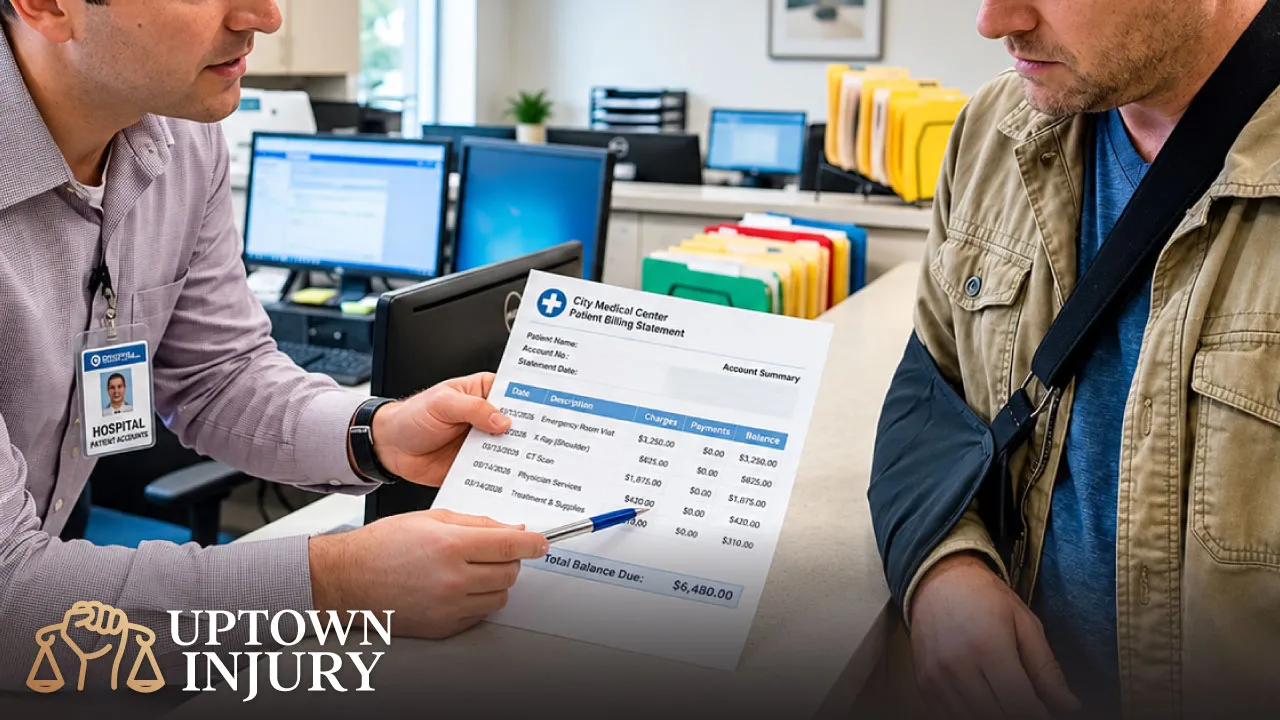
Your medical treatment records, bills, and other documents help show how much the accident has cost you. Keep copies of hospital bills, medical appointments, prescription receipts, and other outstanding medical bills.
You should also collect employment records, pay stubs, out-of-pocket expenses, and proof of lost income. These documents help establish your financial losses. Your settlement amount depends on factors such as injury severity, recovery time, medical expenses, and lost wages.
For example, minor injuries, such as mild whiplash, may involve a shorter recovery period, while severe whiplash can cause chronic pain and require extensive medical care.
If you qualify to pursue a personal injury lawsuit, records of your injuries and their impact on daily life can also help support your claim for pain and suffering.
When Can SUM or Uninsured Motorist Coverage Pay for Injuries?
SUM (Supplementary Uninsured/Underinsured Motorists) can pay for injuries when an at-fault driver has no insurance. It also provides coverage when the at-fault driver has insufficient liability coverage or cannot be identified after a hit-and-run accident.
For example, if another driver causes your accident and carries only $25,000 in bodily injury liability coverage. Your own auto insurance policy provides $100,000 in SUM coverage. If your injuries qualify for compensation beyond the other driver’s available coverage, you may be able to seek additional payment through your SUM policy, subject to its terms and limits.
Under New York Insurance Law § 3420(f)(1), uninsured motorist coverage may apply in situations such as:
- Uninsured drivers: Another driver causes an accident but has no applicable bodily injury liability insurance.
- Stolen vehicles: Someone steals a vehicle and causes an accident without available liability coverage.
- Hit-and-run accidents: An unidentified driver causes bodily injuries and leaves the scene without providing their information.
However, a car accident claim involving an unidentified vehicle requires physical contact with the insured person or the vehicle. You must also report the accident to the police within 24 hours or as soon as reasonably possible under the applicable rules. Your insurer may also require a sworn statement explaining how the accident happened.
How Much Compensation Can You Recover Through SUM Coverage?
The amount you can recover through SUM coverage depends on the value of your injuries, your policy limits, and the at-fault driver’s insurance coverage. It may help cover damages that exceed the limits available under the other driver’s liability policy.
Under 11 NYCRR § 60-2.3, your SUM benefits are generally calculated by subtracting the at-fault driver’s bodily injury insurance payment from your available SUM limit, subject to the policy terms.
For example:
- Your SUM coverage limit is $100,000.
- The at-fault driver’s bodily injury liability limit is $25,000.
- The other driver’s insurance company pays the full $25,000.
- Your SUM coverage may provide up to $75,000 in additional compensation.
However, you do not automatically receive the full SUM policy limit. You must establish that the other driver was legally responsible and prove the value of your injuries and losses.
If an uninsured or underinsured driver injured you, Uptown Injury Law, PLLC can review your insurance coverage and explain your options. Call 917-540-8728 for a free New York car accident case review.
Do You Need to Meet New York’s Serious Injury Threshold?
Yes, you generally must meet New York’s serious injury threshold to recover non economic damages, such as pain and suffering. This rule applies to claims against an at-fault driver, including eligible SUM claims. However, you do not need to meet this threshold to receive basic no-fault benefits for eligible medical expenses and lost earnings.
Under New York Insurance Law § 5102(d), a serious injury may include:
- Significant disfigurement: An injury that causes noticeable and significant changes to your appearance.
- Bone fracture: A broken bone caused by the accident.
- Permanent loss of use: The permanent loss of use of a body organ, member, function, or system.
- Permanent consequential limitation: A lasting and significant limitation affecting a body organ or member.
- System Significant limitation: A significant restriction in the use of a body function or system.
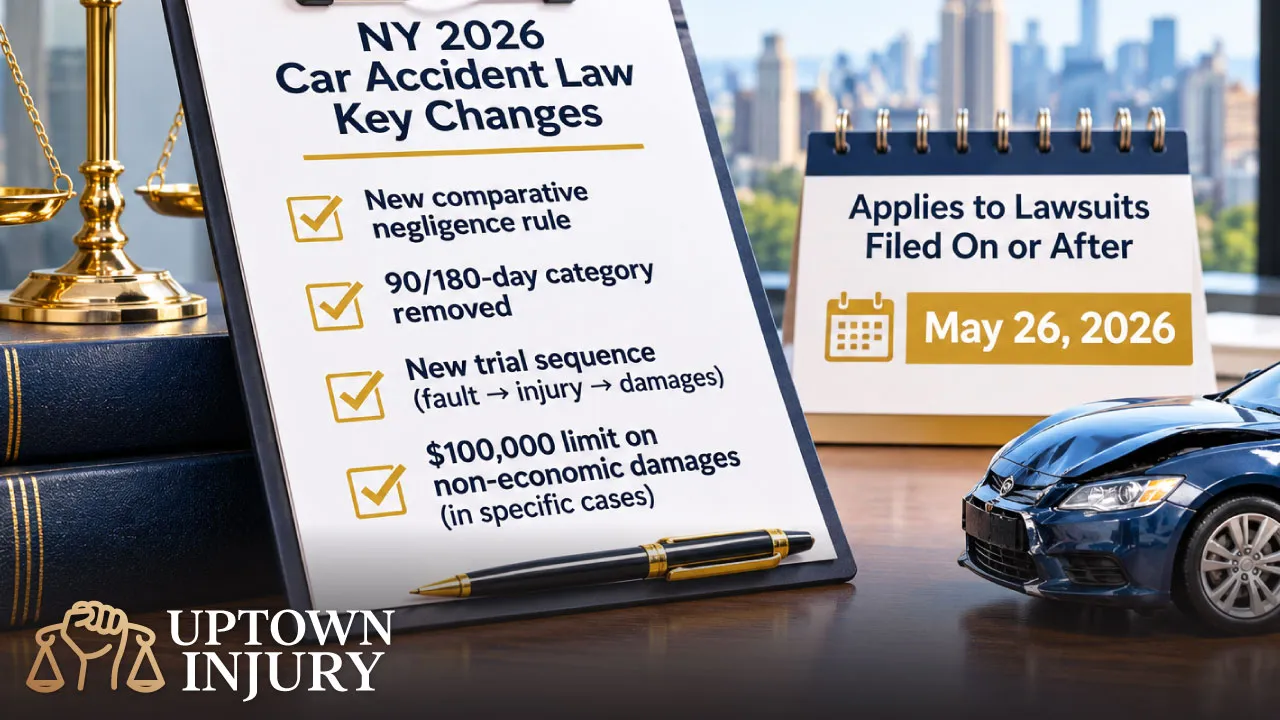
- 90/180-day injury: A medically determined injury that stops you from performing all of your normal daily activities for at least 90 of the first 180 days after the accident.
What Should You Do Before Filing a SUM or UM Claim?
If you want to seek compensation through your own insurance company, report the accident to the police immediately. You should also provide written notice of your UM claim as soon as possible. Keep all documents that support your claim, including:
- Medical records and hospital bills.
- Diagnostic test results and treatment reports.
- Pay stubs and employment records showing lost wages and other financial losses.
- Police and accident reports, photographs of the accident scene, and witness information.
- Medical records documenting ongoing physical pain, emotional distress, and how your injuries affect daily activities.
In addition, before accepting a settlement from the at-fault driver’s insurance carrier, get written consent from your SUM insurer. Settling without approval may affect your right to recover additional compensation under your SUM policy. Your insurer may also investigate the accident, review your medical records, request an examination under oath, or challenge the value of your claim.
Therefore, it’s essential to seek legal counsel from Uptown Injury Law, PLLC. If your insurer requests an examination under oath or recorded information, we can help you prepare appropriate responses. Book your consultation with our New York personal injury lawyers now.
When Can MVAIC Provide Compensation After a Car Accident?
The Motor Vehicle Accident Indemnification Corporation (MVAIC) may provide compensation to people injured in New York car accidents when they cannot recover benefits from an available auto insurance policy. Established under New York Insurance Law Article 52, MVAIC helps eligible accident victims who have no access to traditional auto insurance coverage.
You may qualify for MVAIC benefits in the following circumstances:
- The responsible driver’s identity cannot be established despite reasonable efforts to identify the vehicle, owner, or operator.
- Someone operates a vehicle without the owner’s permission, and their identity cannot be established.
- The at-fault driver’s insurance company disclaims coverage or denies liability under circumstances covered by MVAIC.
Who Qualifies for MVAIC Compensation?
To qualify for MVAIC compensation, you must meet New York’s residency and insurance requirements. Under Insurance Law § 5202(b), a qualified person generally must be a New York resident. He/She must not be an insured person or the owner of the uninsured vehicle (or the owner’s spouse riding as a passenger in that vehicle). Residents of other states may also qualify if their state has a qualifying agreement with New York.
Additionally, MVAIC requires claimants to prove that no other automobile insurance coverage is available. For example, if you do not own a vehicle but live with a family member who has auto insurance, their policy may provide coverage for your accident injuries. In that case, MVAIC may first check whether you can receive benefits through that policy.
What Are the Deadlines for Filing an MVAIC Claim?
To file a MVAIC car accident claim, submit a Notice of Intention (NOI) to MVAIC within 90 days for accidents involving unidentified drivers and 180 days for accidents involving identified uninsured drivers.
However, section 5208 provides a few exceptions for certain late filings, such as:
1. Claimant Was a Minor, Incapacitated, or Deceased
MVAIC may allow a late filing if the injured person is a minor, mentally or physically incapacitated, or deceased. The claimant must provide evidence supporting the reason for the delay.
2. Incorrect Information From the DMV or Police Report
An exception may also apply if the DMV provides incorrect information or a police report contains an error about the vehicle involved.
For example, a police report may identify the wrong vehicle. If you discover the mistake later, you may have additional time to file. However, must submit the required affidavit within 31 days of receiving written notice of the correction.
Who Pays if You Were Partly at Fault for the Accident?
If you were partly responsible for a car accident in New York, you may still recover compensation from the at-fault driver’s insurance company. Under New York’s comparative negligence law (CPLR § 1411), your compensation is reduced by your percentage of fault.
For example, if your total damages are $100,000:
- If you are 20% at fault, you may recover $80,000.
- If you are 10% at fault, you may recover $90,000.
- And if you are 50% at fault, you may recover $50,000.
In such cases, insurance companies often try to assign you a higher percentage of fault to reduce the amount they pay. An experienced car accident lawsuit lawyer can review the evidence and challenge an unfair fault determination.Contact our team for a free consultation.
What Happens if Multiple Drivers Cause a Car Accident?
When multiple drivers cause a car accident, liability is divided among them. This division is made on a pure comparative negligence system. Every driver involved in the crash is assigned a specific percentage of fault based on their actions (speeding or distracted driving). However, if the crash involves an injury, a fatality, or more than $1,000 in property damage, you must file form MV-104 with the New York DMV within 10 days.
How Do Health Insurance and Medicaid Affect Your Compensation?
Health insurance and Medicaid create reimbursement claims for medical bills they paid after your injury. Under Social Services Law § 104-b, Medicaid can seek reimbursement from your personal injury settlement for eligible medical costs related to the accident.
However, Medicaid cannot automatically take money for every type of compensation. Its recovery is limited to the portion of the settlement assigned to past medical expenses. It cannot claim compensation allocated to pain and suffering damages or lost wages.
In contrast, under New York General Obligations Law § 5-335, private health insurers generally cannot seek reimbursement from your personal injury settlement for medical expenses they paid.
How Does Property Damage Compensation Differ From Injury Compensation?
Property damage compensation covers the cost of repairing or replacing your damaged vehicle and other personal belongings. It may also cover loss-of-use expenses, such as the cost of renting a car while yours is being repaired. In contrast, injury compensation covers medical expenses, lost wages, future treatment costs, and pain and suffering.
Under New York Vehicle and Traffic Law § 311(4), drivers must carry at least $10,000 in property damage liability coverage per accident. This coverage pays for damage to another person’s vehicle or property when the insured driver is legally responsible.
However, the amount you can recover depends on the extent of the damage, the vehicle’s pre-accident market value, repair estimates, and the available insurance policy limits. If your vehicle is declared a total loss, compensation generally depends on its actual cash value before the accident.
How Does Compensation Impact Accidents Including Uber/Lyft?
Compensation after an Uber or Lyft accident depends on who caused the crash. It also depends on the driver’s rideshare status, available insurance coverage, and the severity of your injuries. Depending on the circumstances, you may qualify for compensation through the driver’s personal auto insurance.
Moreover, you can get compensation from the rideshare company’s insurance or another at-fault party’s policy. Unlike ordinary car accidents, rideshare claims involve different insurance coverage periods.
Under New York law, the insurance available depends on the driver’s activity, such as:
| Driver’s Status | Applicable Insurance Coverage |
| App turned off | Driver’s personal auto insurance applies |
| App on, waiting for a request | At least $75,000 per person, $150,000 per accident, and $25,000 for property damage |
| Ride accepted or passenger onboard | At least $1.25 million in liability coverage |
Facing Insurance Issues After a Car Accident In New York? Contact Uptown Injury Law, PLLC
After a car accident, dealing with multiple insurance policies, disputed liability, and medical expenses can make it difficult to understand who will pay your compensation. Medicare liens and health insurance reimbursement claims can also affect how much of your settlement you receive.
Uptown Injury Law, PLLC brings 15 years of trial experience and a record of more than $100 million in settlements. We investigate available insurance coverage, review PIP and uninsured motorist benefits, and address Medicare liens. Moreover, our team challenges insurance company disputes over liability or damages. Visit us at 2417 Third Ave., Suite 505, Bronx, New York 10451, or call 917-540-8728 to build a strong personal injury claim.
FAQs
Does My Insurance Pay If The Accident Wasn’t My Fault?
Yes, your own no-fault insurance (PIP) pays for eligible medical expenses. It also pays for lost wages and other necessary economic losses, even if another driver caused the accident. Under Insurance Law § 5103, you can claim these benefits without proving fault.
What If The Other Driver Only Has $25,000 In Coverage?
If the at-fault driver carries only $25,000 in coverage, that policy may not cover your full losses. You may seek additional compensation through your Supplementary Underinsured Motorist (SUM) coverage. But this is only possible if you fulfill eligibility requirements under Insurance Law § 3420(f)(2).
Who Pays My Medical Bills After A Car Accident In NY?
In most cases, your own auto insurance company covers your accident-related medical bills through no-fault benefits. However, if your expenses exceed the $50,000 basic limit, you may need additional coverage. You can also pursue health insurance or other available compensation under New York insurance laws.
Who Pays For My Car Repairs?
The at-fault driver’s insurance company pays for your car repairs. This is only possible if you establish that their insured caused the accident. In some cases, your collision coverage may pay for repairs, subject to your deductible. You also have the right to choose your repair shop under Insurance Law §2610.
How Long Do You Have to File a Car Accident Lawsuit in New York?
You generally have three years from the accident date to file a personal injury lawsuit in New York. However, claims involving government entities may have shorter filing deadlines. Check the applicable deadline promptly, as missing it could prevent you from recovering compensation.