Does the 2026 Car Accident Law Apply to My Crash?
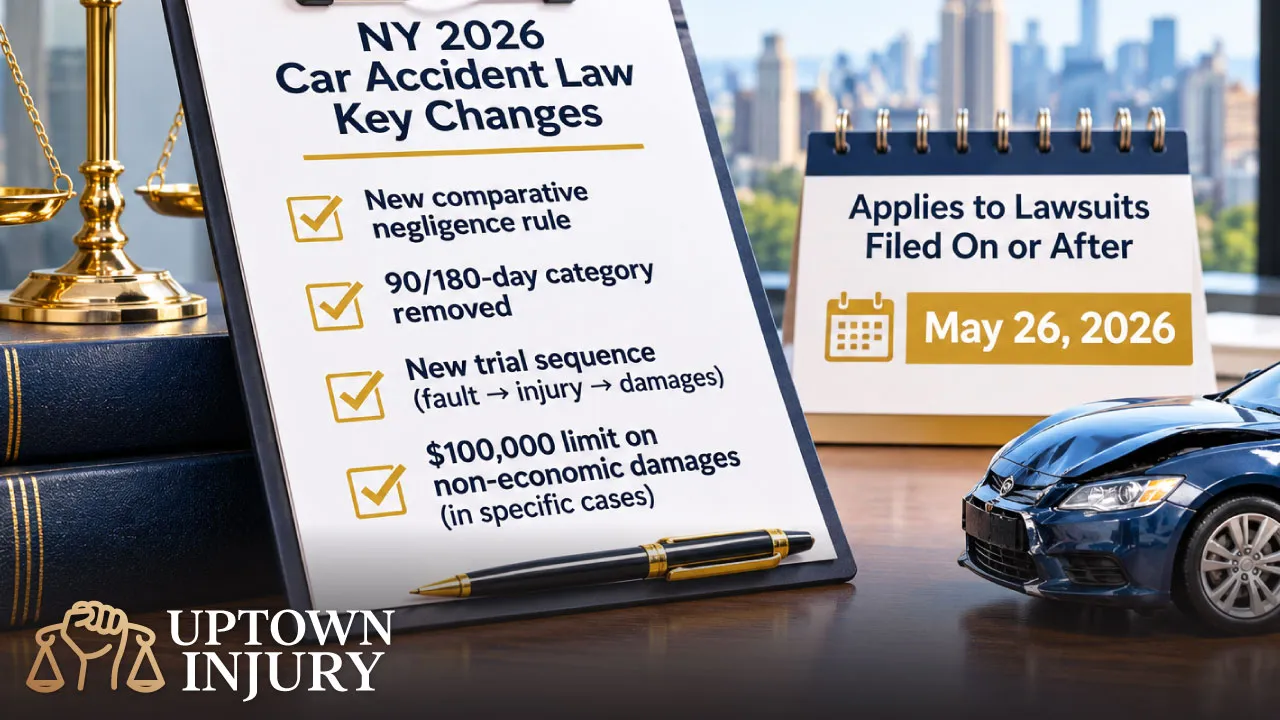
New York’s 2026 car accident law may apply to your case based on when you filed your lawsuit. If you filed before May 26, 2026, your case follows the old rules. However, lawsuits filed on or after that date may fall under the new law. At Uptown Injury Law, PLLC, our New York car accident lawyers review your accident date, lawsuit filing date, and medical records to explain how the NY 2026 law changes may affect your claim. We help you understand the legal process and pursue the fair settlement available under New York law. Call 917-540-8728 for a free case review.
Key Takeaways
- New York’s 2026 car accident reforms generally apply to lawsuits filed on or after May 26, 2026.
- Under the new comparative negligence rule, your compensation depends on how your fault compares with the defendant’s combined fault.
- The new law removes the 90/180-day serious injury category, which may affect your ability to recover non-economic damages.
- The new trial process requires juries to determine who caused the accident before they consider whetherthe victim suffered a serious injury.
- The law limits non-economic damages in specific cases involving uninsured vehicles, qualifying distracted or intoxicated driving offenses, or felony-related conduct.
- Claims involving government vehicles and wrongful death may have shorter deadlines.

How Does the 2026 Car Accident Law Affect Your Case?
Under Part EE of Chapter 58, New York’s 2026 amendments affect your ability to recover compensation after a crash. For car accident lawsuits filed on or after May 26, 2026, the law modifies the comparative negligence rules. It also removes the 90/180-day serious injury category.
Additionally, it changes how courts determine fault and serious injury, and caps certain non-economic damages. Here are the key 2026 amendments that may affect your New York’s car accident claim, fault determination, and the injuries qualifying for compensation:
1. New Comparative Negligence Rule
Under CPLR § 1411(b), the 2026 law adds a modified comparative negligence standard for motor vehicle personal injury lawsuits. Under the new rule, you cannot recover damages if your share of fault is greater than the defendants’ combined fault.
For example, you cannot recover damages if you are 60% responsible for the crash and the defendant is 40% responsible. However, if both sides share equal fault, you can still recover 50% of your damages.
This is a major change from New York’s old pure comparative negligence rule. Under the old rule, injured victims could still recover damages even if they were mostly at fault.
2. Removal of the 90/180-Day Serious Injury Category
New York also removed the 90/180-day serious injury category from Insurance Law § 5102(d).
Under the old rule, you could qualify for a serious injury claim if a medically confirmed injury prevented you from performing all your usual daily activities substantially for at least 90 days during the first 180 days after the accident.
The new law removes this category. You must now meet another serious injury category under Insurance Law § 5102(d) to pursue non-economic damages, such as pain and suffering. This change may affect victims with temporary injuries that limit their daily activities but do not fall into another serious-injury category.
If you are unsure whether your bodily injury qualifies, review your medical records and car accident claim with an attorney.
3. New Trial Sequence
The 2026 law changes the order in which a jury reviews a car crash under Insurance Law § 5104(a).
Previously, courts could address fault and serious injury in a different order. Under the new rule, the jury must follow three steps:
- Determine fault: The jury decides who caused the accident and assigns each party a share of responsibility.
- Review the injury: The jury decides whether the injured person meets the serious injury threshold.
- Determine damages: If the legal requirements are met, the jury decides the amount of compensation.
4. $100,000 Limit on Non-Economic Damages
The new law adds a $100,000 cap on non-economic damages such as pain and suffering under Insurance Law § 5104(d) for certainat-fault drivers.
The cap applies when the injured person is not otherwise barred from recovery and was:
- Driving an uninsured vehicle they were legally required to insure, unless the coverage lapse was less than 30 days.
- Driving while impaired by alcohol or drugs and later convicted of the qualifying offense.
- Committing a felony, or fleeing immediately after committing one, while driving and later convicted of that felony.
However, the cap applies to non-economic damages, not all compensation. It does not limit your economic losses, such as medical bills and lost income. It also does not apply to wrongful death lawsuits.
Can the New 90/180-Day Rule Affect My Pending Lawsuit?
No, the repeal of the 90/180-day rule in New York does not affect lawsuits that were pending before May 26, 2026. If you filed your car accident lawsuit before May 26, 2026, your case continues under the previous legal standards. This means you can still rely on the 90/180-day serious injury category.
You can find more details about the law on the New York State Legislature website. You can also speak with our attorney for a free case evaluation.
Can You Challenge the NY 2026 Car Accident Law in Court?
Yes, you may challenge the 2026 car accident law if you believe it violates your legal or constitutional rights. For example, you may question whether the law treats you fairly or limits your right to recover damages.
However, filing a challenge does not stop the law from applying to your case. A court must review the legal arguments before it can grant relief.
If you prove that a part of the law violates your legal rights, the court may refuse to apply that part to your case. It may also grant other legal relief.
The table below shows how the accident date and lawsuit filing date may affect which rules apply.
| Accident Date | Lawsuit Filing Date | Which Rules May Apply? |
|---|---|---|
| Before May 26, 2026 | Before May 26, 2026 | The old rules apply. These include the 90/180-day serious injury category. |
| Before May 26, 2026 | On or after May 26, 2026 | The new rules may apply, even if the accident happened before the law took effect. |
| On or after May 26, 2026 | On or after May 26, 2026 | The new rules generally apply |
What Happens If You Delay Filing Your Car Accident Lawsuit?
Waiting too long to file a car accident lawsuit can put your right to compensation at risk. Under CPLR § 214(5), you generally have three years from the accident date to file a personal injury lawsuit. If you miss this deadline, the court may dismiss your case.
Moreover, witnesses may forget what they saw, and police reports may become harder to find. Important evidence, such as traffic camera footage, medical expense records, and accident scene photographs, may also become unavailable. The missing evidence can make it difficult to prove who caused the crash and how badly you were injured.
Besides this, gaps in medical care can let an insurance company argue that your injuries resulted from a different accident. However, exceptions in deadlines may apply in certain cases:
- Accidents involving commercial vehicles: If a city, county, or other public entity caused your accident, you may need to file a Notice of Claim within 90 days under General Municipal Law § 50-e. The lawsuit must be filed within 1 year and 90 days under CPLR § 217-a.
- Wrongful death claims: Under EPTL § 5-4.1, an eligible representative generally has two years from the date of death to file a wrongful death lawsuit.
Do not assume that an insurance claim or ongoing medical care will pause your lawsuit deadline. If you have delayed taking legal action, speak with our attorney at Uptown Injury Law, PLLC. We can review your accident date and filing deadlines. Our team can also explain your options for third-party claims and help you avoid costly mistakes that may affect your right to compensation.
When Must You File a Personal Injury Protection (PIP) Claim?
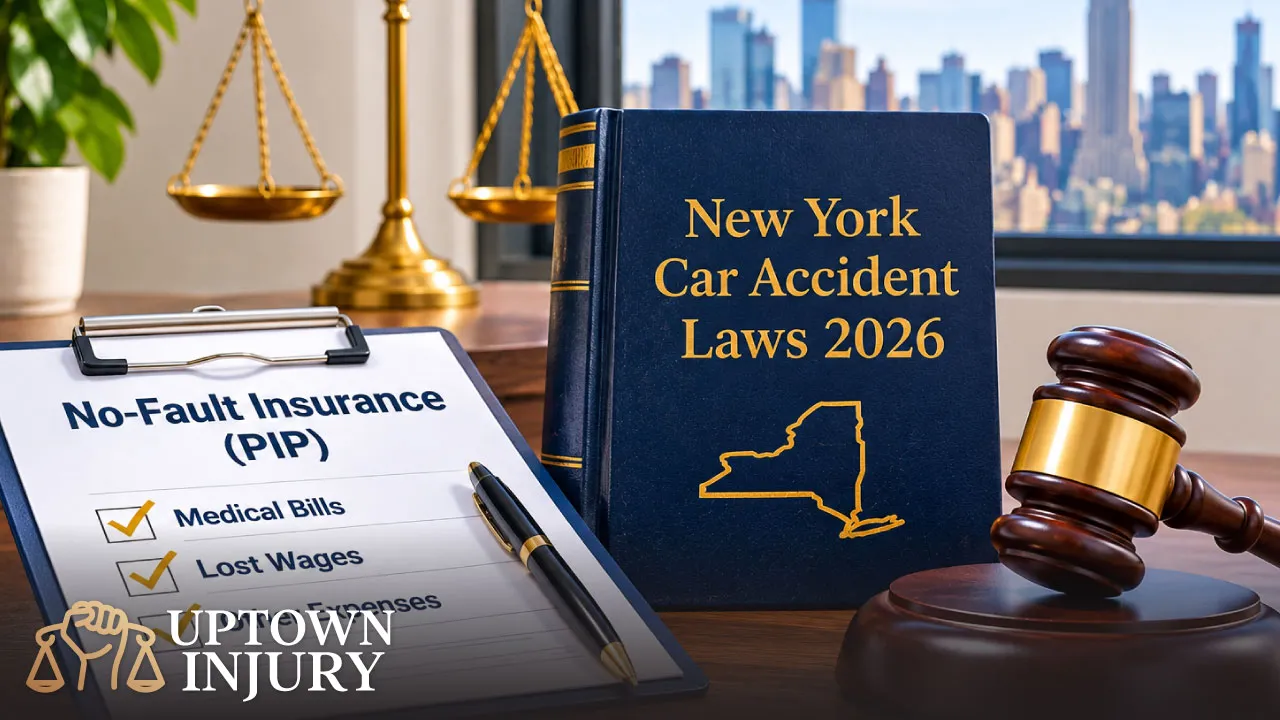
New York’s no-fault system generally requires you to notify the insurer in writing within 30 days of the accident to request Personal Injury Protection (PIP) benefits. These benefits can cover medical treatment expenses, a portion of your lost wages, and other necessary expenses, regardless of who caused the crash. If you miss this deadline, the insurer may deny your claim unless you provide a clear and reasonable justification for the delay.
Important: This 30-day PIP notice deadline is separate from the deadline for filing a personal injury lawsuit.
What Changed in New York’s DMV Point System in 2026?
Starting February 16, 2026, New York changed how it assigns points for traffic violations and reviews drivers’ records. The updated DMV point system increases penalties for several violations and extends the look-back period from 18 to 24 months. This means the DMV now considers a longer period of driving history when determining whether a driver has accumulated enough points for a possible license suspension.
Under the new rules, accumulating 11 or more points within 24 months can lead to license suspension. Drivers who accumulate 7 to 10 points during this period may also be required to attend a driver improvement clinic.
The updated system assigns higher point values to several traffic law violations:
- Alcohol- or drug-related driving offenses: Increased from 0 to 11 points.
- Aggravated unlicensed operation: Increased from 0 to 11 points.
- Passing a stopped school bus: Increased from 5 to 8 points.
- Speeding in a work zone: Now carries 8 points.
- Leaving the scene of an accident involving personal injury: Increased from 3 to 5 points.
- Failure to exercise due care: Increased from 2 to 5 points.
The new point values apply to violations committed on or after February 16, 2026. Earlier violations remain subject to the previous point values. You can check the complete list of New York DMV point values to see how different violations affect your driving record.
Can DMV Points Affect Your Car Accident Claim?
DMV points mainly affect your driving record and license status. However, the traffic violation behind those points may also be relevant to a car accident claim. For example, if another driver caused your crash by speeding, passing a stopped school bus, or failing to exercise due care, evidence of that violation may help establish how the accident happened and who was responsible.
However, a driver’s point total does not automatically determine fault. Your car accident claim will depend on the available evidence and the circumstances of the crash.
What Common Mistakes Can Affect Your Car Accident Claim?
Failing to exchange information, delaying medical care, and admitting fault can weaken your car accident claim. Giving recorded statements, signing broad medical authorizations, and failing to preserve evidence can also give insurance companies reasons to challenge your case.
You should also understand the reporting requirements and insurance regulations that may apply to your accident. Here are common mistakes that can affect your case under New York’s 2026 car accident law:
1. Failing to Exchange Information After an Accident
Always exchange details with the other driver after a car accident. Get their name, contact details, insurance company, policy number, and driver’s license number. Also, collect vehicle details and contact information from any witnesses.
Under Vehicle and Traffic Law § 600, drivers must share certain details after an accident. They must also meet the law’s reporting duties. Leaving without sharing this information can create legal problems. It may also make it harder to find the driver responsible for the crash.
2. Giving Recorded Statements to an Insurance Adjuster
An insurance adjuster may ask you to give a recorded statement soon after the crash. You may not know all the facts at that time. You may also guess about what happened or describe your injuries before your doctor completes an exam.
Before you agree, ask who wants the statement and why. Do not guess about details you cannot recall. Also, avoid downplaying your injuries or accepting blame before you know what happened.
3. Delaying a Medical Evaluation
Waiting to see a doctor can harm your health and your claim. Some injuries, such as neck, back, and head injuries, may not cause clear symptoms right away.
A long gap between the crash and your first visit may also give the insurer a reason to question your injuries. So, seek medical care as soon as you can. Follow your treatment plan and keep copies of your medical records.
4. Signing a Broad Medical Authorization
An insurance adjuster may ask you to sign a medical authorization form. This form may let the insurer review health records that have little to do with your accident. It could include records of past health issues.
Before you sign, check which records the form covers. Also, see how far back the insurer wants to look. Ask whether a limited form for accident-related treatment records will meet its needs.
5. Admitting Fault Before Knowing What Happened
Do not assume you caused the crash just because you were involved. Also, avoid saying sorry in a way that could be taken as an admission of fault.
Fault may depend on many facts. These include traffic signals, witness statements, vehicle damage, and road conditions. Let the evidence show what happened before you accept blame.
6. Failing to Preserve Evidence of Distracted Driving
Distracted driving can play a key role in deciding who caused a crash. If you do not save critical evidence, it may be harder to prove what happened.
Take photos of the crash scene and collect witness details when it is safe. If you think the other driver was texting or using a phone, tell your attorney. Your lawyer can review what evidence may help support your claim and how to preserve it.
7. Missing Insurance and Accident Reporting Deadlines
Waiting too long to notify your insurer or file required accident reports can create problems with your claim.
Under New York’s no-fault rules, you generally must submit written notice of your claim within 30 days of the accident. You may also need to file Form MV-104 with the DMV within 10 days if the crash caused an injury, death, or property damage exceeding $1,000.
If you miss a reporting deadline, you may face complications with your insurance claim. Keep copies of the forms you submit and confirm that the insurer or DMV receives them.
8. Overlooking Insurance Rules for Rideshare and Uninsured Drivers
The insurance coverage available after a crash may depend on the type of vehicle involved and the circumstances of the accident.
For example, if an Uber or Lyft driver caused your injuries, the available coverage may depend on whether the driver was waiting for a ride request or carrying a passenger. Different insurance requirements apply at each stage.
If an uninsured driver caused the crash, you may be able to file a claim under your uninsured motorist (UM) coverage. You may also qualify for benefits through the Motor Vehicle Accident Indemnification Corporation (MVAIC) if no other applicable coverage is available.
Facing a Car Accident Claim Under New York’s 2026 Law? Consult Uptown Injury Law, PLLC
A change in the law can change the direction of your car accident case. New fault standards, revised serious injury requirements, and limits on certain damages could affect what you can recover. If your lawsuit falls under the new rules, you need to understand how these changes apply before making decisions about your claim.
At Uptown Injury Law, PLLC, we look at the legal details that could make or break your case. We evaluate the evidence, examine your injuries, and develop a strategy based on the facts of your accident and the applicable law. Call 917-540-8728 to put your case in the hands of a team ready to fight for your rights.
You can also visit our office at 2417 Third Ave., Suite 505, Bronx, New York 10451 for a free consultation!
FAQs
Does The New Law Apply To Accidents Before 2026?
Yes. The new law may apply to accidents that happened before 2026 if you file your lawsuit on or after May 26, 2026. The filing date, not the crash date, generally determines which rules apply. If you filed your lawsuit before May 26, 2026, the previous legal standards generally remain in effect.
Is It Too Late To File Under The Old Rules?
To qualify under the old rules, you generally must have filed your lawsuit before May 26, 2026. If you file on or after that date, the new legal requirements apply, even if your accident happened earlier. However, missing the old-law cutoff does not mean you lose your right to compensation; you may still pursue a claim under the updated rules.
What If My Case Was Filed In April 2026?
If you filed your car accident lawsuit in April 2026, the previous New York legal rules generally apply. This is because your filing date falls before the May 26, 2026, effective date of the new law. Therefore, your case is not subject to the updated fault standards, serious injury requirements, or damage limits introduced by the 2026 reforms.