Can You Still Sue for a 90-Day Car Accident Injury in NY?
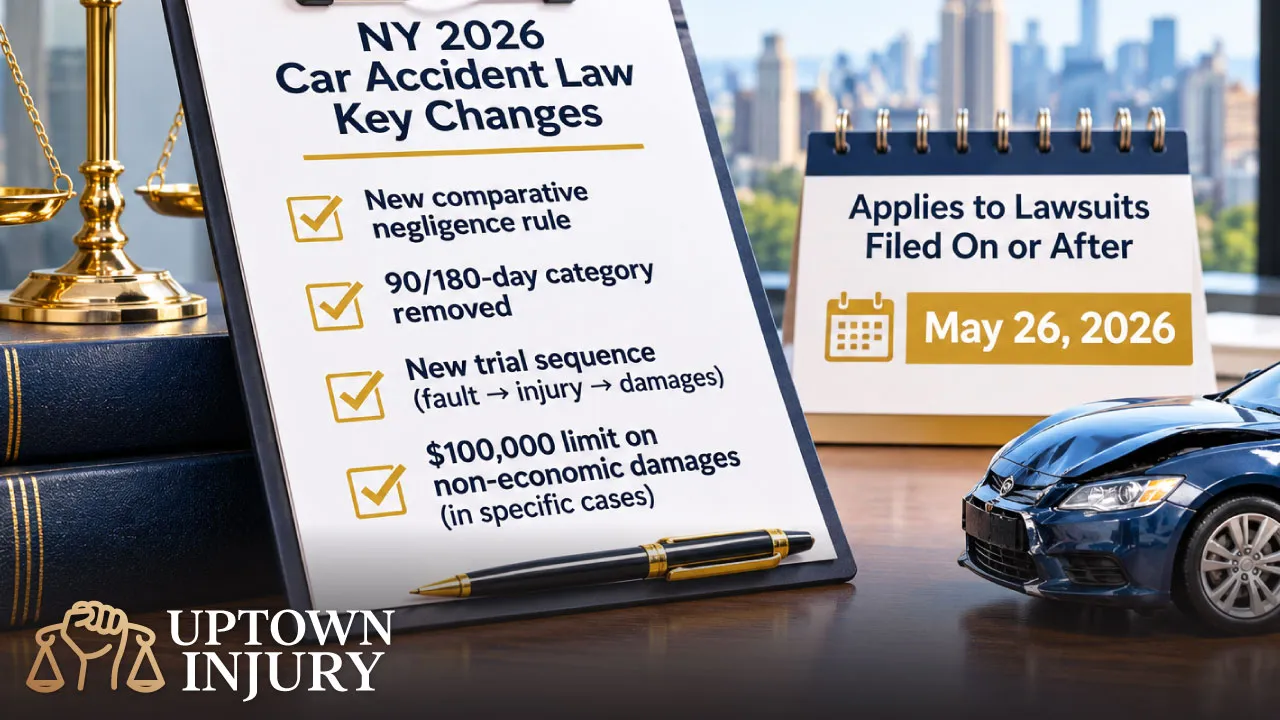
Yes, you may still sue for a car accident injury that lasts 90 days or longer in New York, but your eligibility depends on whether your injury meets the state’s serious injury threshold. For lawsuits filed on or after May 26, 2026, the 90/180-day category no longer qualifies. However, injuries such as fractures or significant limitations may still support a claim.
If you are unsure whether your car accident injuries qualify for compensation, Uptown Injury Law, PLLC can help you understand your legal options. Our team can review your medical records, assess how your injuries have affected your daily activities, and determine whether your case meets New York’s serious injury threshold. Call 917-540-8728 for a free case review.
Can a 90-Day Car Accident Injury Qualify for a Lawsuit in NY?
If your lawsuit is filed on or after May 26, 2026, you must meet New York’s serious injury threshold under Insurance Law § 5102(d) to pursue compensation for a car accident injury. A 90-day injury alone may not qualify unless it meets the applicable legal requirements.
To establish a qualifying serious injury, you may need to demonstrate:
- A qualifying injury: Such as a fracture, significant disfigurement, or permanent limitation of a body organ or member.
- Medical evidence: Records, diagnostic tests, and physician evaluations supporting the severity of your injury.
- Impact on daily life: Evidence showing how the injury affected your mobility, work, or routine activities.
You must also establish a direct connection between the accident date and the claimed injury. If you had a pre-existing condition, medical records comparing your health before and after the collision may help clarify whether the crash caused a new injury or worsened an existing condition.
What Is the 90-Day Injury Threshold Rule?
The 90-day injury threshold rule is a legal standard in personal injury claims and no-fault insurance law that dictates whether an accident injury victim can sue for pain and suffering. It requires proof that a significant disfigurement, bone fractures, and permanent limitations prevented a person from performing their usual daily activities for at least 90 days out of the 180 days following an accident.
The 90 days of impairment need not be consecutive, provided they occur within the first 180 days following the accident. Under this rule, courts require official medical records, doctors’ diagnoses, or functional testing to support the claim, rather than relying solely on the injured party’s statement. However, missing the 90-day deadline usually bars your claim.
Can You Sue If You Returned to Work Within 90 Days?
Yes, you can still sue in New York if you return to work within 90 days of a car accident. However, your eligibility for compensation depends on the severity of your injuries, the evidence supporting your claim, and the legal requirements that apply to your case.
If you were injured in a car accident and want to sue for pain and suffering, New York State Insurance Law requires you to prove you suffered a “serious injury.” Moreover, if you returned to your normal job duties within those first 90 days, the defense or insurance company will use this as strong evidence to argue that your injuries were not “serious”. It makes winning a lawsuit under this specific category much more difficult.
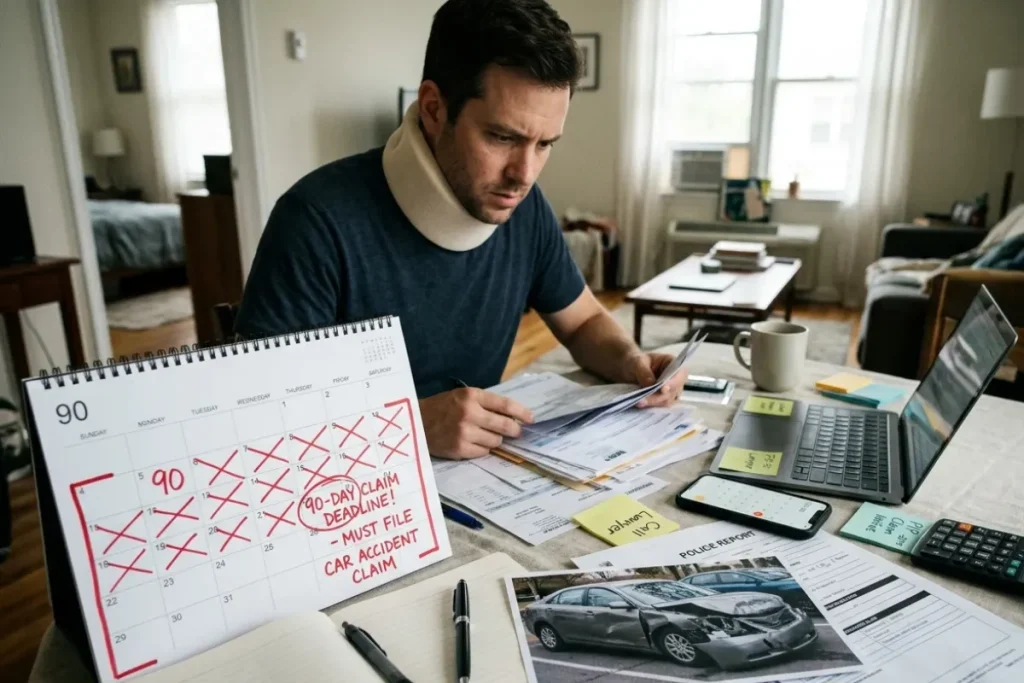
On the other hand, if your injury involved a government entity (like a public school or a poorly maintained city sidewalk), you must file a Notice of Claim within 90 days after the accident under General Municipal Law § 50-e. The Notice of Claim informs a municipal entity of your intent to sue. Returning to work does not change this strict deadline. Even if you go back to work on day 10, you still have until day 90 to complete the procedural requirement. However, any error in the Notice of Claim can lead to objections.
Similarly, if you were injured on the job in NYC, you cannot sue your employer for negligence. Instead, you have up to two years to file a workers’ compensation claim under New York Law § 28. You can return to work within 90 days and still file your claim for medical care coverage. However, your weekly lost-wage checks will stop or decrease once you return to full pay. This is because wage-replacement benefits are tied strictly to your actual lost income.
What Evidence Proves a 90-Day Car Accident Injury?
To prove your car accident injury lasts for 90 days or longer, you must provide clear objective medical documentation, a consistent treatment history, and proof of functional limitations. If your injury impacted your ability to earn a living, you should also collect financial records. Similarly, you may need a formal report written by your treating doctor explaining how the car crash caused the injuries and why recovery required 90 days.
Here is how this evidence helps you prove a 90-day injury:
1. Urgent Care Records
Urgent care records help establish that you got medical attention shortly after the car accident. They document your reported symptoms, the injuries identified during the initial examination, and the treatment you received. These records can help connect your injuries to the collision and establish when your symptoms began. Additionally, early medical documentation provides a starting point for tracking your injury and continuous treatment.
2. Diagnostic Imaging and Test Results
Preserving evidence such as diagnostic imaging and other medical tests can prove that you sustained injuries in a car accident. X-rays may identify fractures, while MRIs can reveal herniated discs and certain soft-tissue injuries. Similarly, CT scans and electromyography (EMG) may help identify specific injuries or nerve-related problems when medically appropriate.
3. Medical Progress Notes and Follow-Up Records
Medical progress notes document your condition throughout the recovery period. Records from your physician, physical therapist, or other treating providers may describe persistent pain and reduced range of motion. It also provides details about muscle weakness, difficulty walking, and changes in your ability to perform routine activities.
Consistent follow-up records can also establish how your injury affected you over time, including whether your symptoms persisted and whether your physical abilities gradually improved. Moreover, they can show that you followed the prescribed treatment plan and continued to experience documented limitations.
4. Physician’s Written Restrictions and Medical Orders
Written restrictions from your doctor can document the activities you were advised to avoid during recovery. These may include lifting heavy objects, standing for prolonged periods, bending repeatedly, driving, or performing physically demanding work. Your physician may also recommend light-duty employment or a temporary leave from work.
These medical restrictions provide professional support for your claim that the injury interfered with your normal activities. For example, a physician’s order limiting lifting may help explain why you could not perform the physical requirements of your job. Dated restrictions can also help establish when your limitations began and how long they continued.
5. Daily Activity Logs and Personal Injury Journals
A daily activity log can help document how your injuries affected your everyday life during recovery. You can record activities you struggled to perform, symptoms you experienced, assistance you needed, and changes in your physical abilities. Examples include difficulty cooking, cleaning, driving, sleeping comfortably, lifting your child, or completing personal care tasks.
Keep your journal entries factual, dated, and consistent with your medical records. Although a personal journal can support your injury claim, it does not replace medical documentation. Be honest about your symptoms, and avoid exaggerating your pain or including details you cannot accurately recall.
6. Witness Statements and Testimony
Statements from a reasonable person who regularly observed you after the accident can help demonstrate changes in your physical abilities and daily routine. Family members, friends, neighbors, and coworkers may describe specific activities you could perform before the collision but struggled with afterward.
7. Employment Records and Attendance Documentation
Employment records can help establish how your injuries affected your ability to work. Relevant documents may include the following:
- Attendance records
- Timecards
- Payroll statements
- Approved leave requests
- Return-to-work records
- Correspondence confirming that you were assigned modified duties
These records can corroborate missed workdays, reduced hours, or changes in your job responsibilities during recovery. For example, attendance records may establish the dates you were absent. On the other hand, modified-duty documentation indicates that your employer adjusted your responsibilities due to your physical restrictions.
8. Lost Wage Verification Form
A lost wage verification form is a document completed by your employer to confirm work absences and income lost because of your injury. Depending on the form, it may include your regular pay rate, missed work or hours, reduced earnings, and any modified work arrangements.
The form can support a personal injury case for lost earnings by providing employer-verified information about the financial impact of your injury. When the dates align with your medical records and physician-imposed restrictions, it can also help corroborate the timeline of your recovery.
What If Your Doctor Restrict Normal Activities for 90 Days?
A doctor’s restrictions can help establish how your injuries and major surgeries affected your daily life. For instance, a three-month window is a common biological timeframe for deep-tissue healing, bone remodeling, and cardiovascular stabilization. Doctors may issue restrictions in such cases to protect you from re-injury, internal bleeding, or structural failure of surgical repairs.
But the medical records must connect those limitations to the accident. Therefore, you should keep copies of work restrictions, treatment notes, and daily activity records documenting which activities you could not perform and for how long. In addition, attend scheduled appointments, so your doctor can assess your recovery and document any ongoing limitations. If this evidence helps to prove a significant limitation, you may qualify for fair compensation.
Can You Sue If the Insurance Company Downplays Injuries?
Yes, you can sue an insurance company if they unreasonably downplay or devalue your injury claim. However, for this purpose, you may need to prove that their low offer or undervaluation constitutes a breach of contract or “bad faith”.
The following steps can strengthen your claim and help you determine whether further legal action is appropriate:
1. Review Your Insurance Policy and Coverage
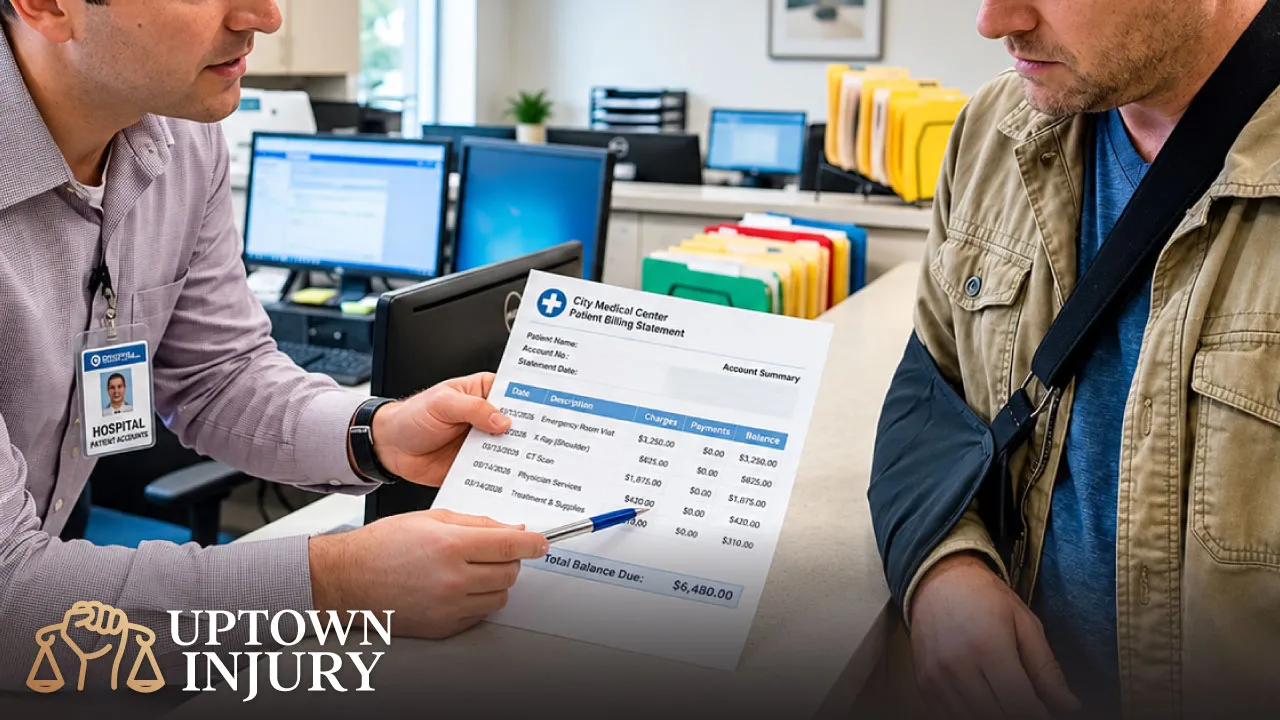
Read your insurance policy carefully to understand the benefits, exclusions, coverage limits, and procedures that apply to your claim. For instance, New York’s no-fault insurance covers medical bills up to $50,000.
Moreover, lost-wage payments under no-fault are capped at $2,000 per month. If the insurer undervalues your injuries, compare its explanation with the policy terms and the benefits available under your coverage. This review can help you identify disputed amounts, missing payments, or potential violations of the insurance contract.
2. Gather Medical and Claim Documentation
Collect your medical records, imaging results, physician reports, treatment notes, medical bills, proof of lost wages, and correspondence with the insurance company. These documents can help establish the severity of your injuries, the treatment you received, and the financial impact of the accident. If your claim involves an applicable earlier version of New York’s 90/180-day serious injury category, keep records showing how your injuries affected your daily activities during the relevant period.
3. Submit a Formal Dispute or Appeal to the Insurer
If you disagree with the insurer’s assessment, submit a written dispute explaining why the accident settlement offer is too low. Point out what the insurer may have overlooked, such as the severity of your injuries, ongoing medical treatment, medical expenses, or lost income. Request a written explanation of its decision, follow the applicable review procedures and deadlines, and keep copies of all correspondence for your records.
4. Consult a Personal Injury Lawyer
Our attorneys at Uptown Injury Law, PLLC, can review the insurance company’s offers, assess the evidence supporting your claim, and explain your legal rights. We can also determine whether your injuries meet New York’s serious-injury threshold for pursuing pain and suffering damages and whether you have grounds to bring a lawsuit against the at-fault driver or another responsible party.
Additionally, our personal injury attorneys can help identify the statute of limitations that apply to your case, including any special notice requirements for claims involving government entities. As missing a deadline can jeopardize your right to seek compensation, it is important to understand the legal process as early as possible.
Contact Uptown Injury Law, PLLC today for a free consultation to discuss your claim and the next steps toward pursuing compensation.
Does No-Fault Insurance Prevent You From Filing a Lawsuit?
No, New York’s no-fault insurance system does not prevent you from filing a personal injury lawsuit after a car accident. However, pursuing a claim for pain and suffering against the at-fault party generally requires proof of a qualifying serious injury.
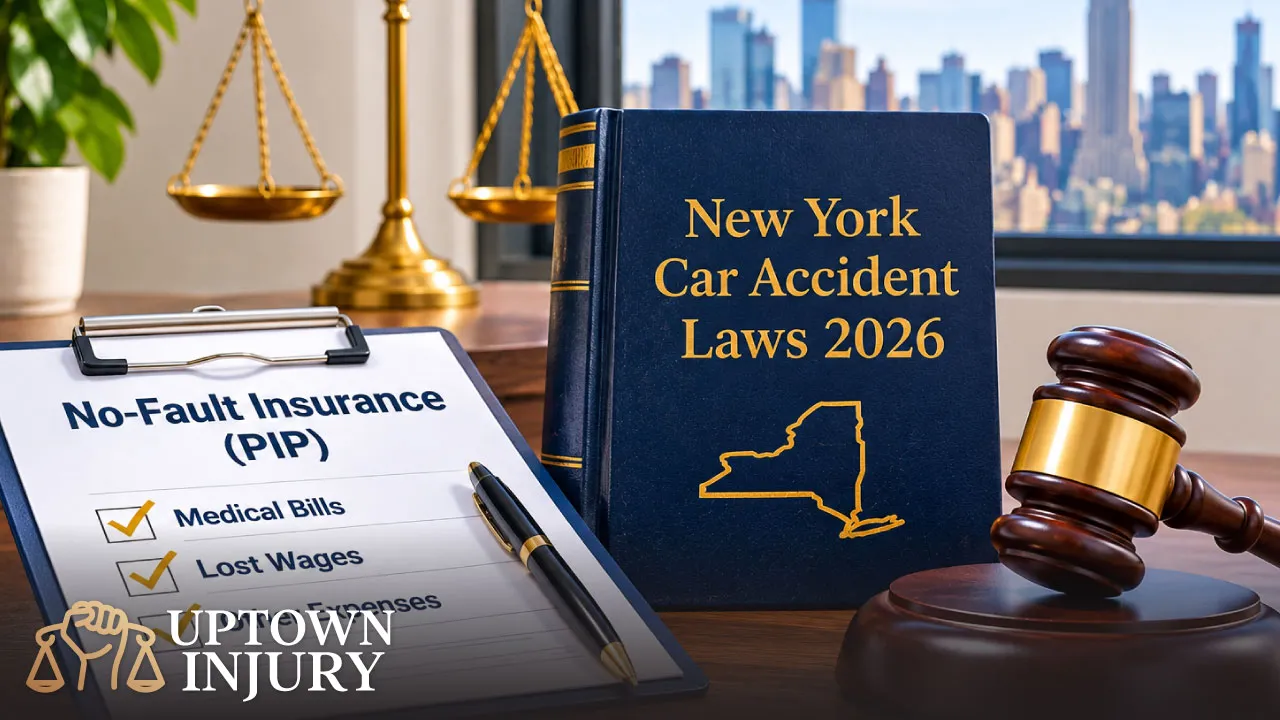
Besides that, New York’s no-fault system generally requires injured people to seek reimbursement for reasonable and necessary medical expenses and certain lost wages through their own Personal Injury Protection (PIP) coverage. Through this system, you may be able to pursue a claim against the at-fault driver for:
- Pain and suffering: Compensation for physical pain, emotional distress, and other qualifying non-economic losses when the serious-injury requirement is met.
- Medical expenses exceeding coverage: Accident-related expenses that exceed available no-fault benefits.
- Lost income and other financial losses: Eligible losses that exceed no-fault benefits or fall outside their coverage may be recoverable through a third-party claim.
What Is the 30-Day No-Fault Deadline After a Car Accident?
The 30-day no-fault deadline is the strict time limit to submit a written notice or an application for no-fault benefits claims to your auto insurance company after a car accident. Under applicable policy requirements, medical bills must be submitted within 45 days, while insurance claims for lost earnings must be submitted within 90 days.
Therefore, you must act quickly to secure your personal injury protection (PIP) coverage. In case of late notice submission or a missed deadline, you can lose your medical coverage. Insurance companies may also deny your lost wages, or you might face high out-of-pocket bills due to late filings. To avoid any legal complexities, you should follow these steps:
- Send written notice immediately.
- Include date, time, and location details.
- Attach police reports and medical bills.
- Keep copies of all submitted documents.
Can You Sue After Your Car Accident Claim Is Denied?
Yes, you can sue after your car accident claim is denied in New York, but your legal options depend on the type of claim, the reason for denial, and the applicable lawsuit deadlines. Before challenging the insurer’s decision or pursuing a lawsuit against the at-fault driver, check if you are legally eligible to do so.
Next, file an internal appeal by submitting missing documents, correcting errors, or providing extra evidence like photos and police reports. If another driver caused the crash and their insurer refuses to pay, you can file a personal injury or property damage lawsuit directly against that driver. However, if your own insurance company rejected a valid claim without a legitimate reason, get legal help from Uptown Injury Law, PLLC attorneys.
Our legal team can review the insurer’s explanation and identify gaps in your documentation. We can help you strengthen your claim by gathering medical records, treatment notes, police reports, photographs, witness statements, and employment records. Additionally, we review your policy, examine the basis for the denial, and assess available options for challenging the decision. Book your consultation to discuss your denied car accident claim.
What If Your Injury Was Minor at First but Worsen Later?
If your car accident injury seemed minor initially but worsened later, you can file a lawsuit in New York. However, you must meet the state’s serious injury threshold to pursue pain and suffering damages and provide medical evidence linking your worsening condition to the accident.
Some injuries do not produce noticeable symptoms immediately after a collision. Adrenaline, inflammation, and delayed muscle soreness can make symptoms more apparent hours or days later. Soft-tissue injuries, herniated discs, and certain head injuries may also become more noticeable as symptoms develop. But seek medical evaluation promptly, especially if you develop new symptoms, increasing pain, numbness, weakness, or reduced mobility.
Moreover, if your condition deteriorates after the accident, take the following steps to support your claim:
- Obtain updated medical records: Visit your doctor when symptoms worsen. Explain how your condition has changed since the collision. Follow the recommended treatment plan.
- Keep diagnostic test results: MRI scans, X-rays, and other medically appropriate tests may help identify injuries that were not apparent during your initial evaluation.
- Document your daily limitations: Record difficulties with walking, lifting, driving, working, sleeping, or completing household tasks. Keep any relevant work restrictions or medical notes.
- Preserve your initial records: Emergency room reports, urgent care notes, and earlier examinations can help establish when symptoms began and how your condition progressed.
- Maintain consistent treatment records: Gaps in treatment may raise questions about the severity of your condition or its connection to the accident. If you could not attend appointments, document the reason.
Besides that, do not sign any settlement agreements until a medical professional has fully diagnosed the extent of your condition. Signing too early can prevent you from seeking compensation for long-term complications that appear later.
Can You Sue If You Didn’t Seek Medical Treatment Immediately?
Yes, you can sue after a car accident, even if you did not seek immediate medical treatment. However, delaying care may make it harder to prove your injuries resulted from the crash. Insurance companies may argue that a delay in treatment suggests your injuries were minor or caused by another condition.
This argument can complicate negotiations, particularly when your medical records do not explain when symptoms began or how they progressed. To strengthen your claim, take the following steps:
- Seek medical evaluation promptly: Explain when the accident occurred. Describe which symptoms you experienced initially and whether your pain developed or worsened later.
- Explain the delay honestly: If you initially felt fine or lacked transportation, tell your healthcare provider the actual reason.
- Follow your treatment plan: Attend recommended appointments and document any unavoidable gaps in care.
Get Legal Guidance from Uptown Injury Law, PLLC to Pursue Compensation After a Serious Injury!
If your car accident injuries have affected your daily activities for 90 days or longer, proving the extent of your injuries may be challenging. Gaps in medical treatment, disputed diagnoses, or incomplete records can make it harder to support your claim.
Recognized with the Multi-Million Dollar Advocates Forum title, Uptown Injury Law, PLLC, lawyers can help you review medical records, police reports, diagnostic findings, and other evidence. We help identify evidence that is legally required to establish causation, address insurance company disputes, and evaluate available compensation. Visit us at 2417 Third Ave., Suite 505, Bronx, New York 10451, or call 917-540-8728to file your claim on time.
FAQs
Can a Pre-Existing Condition Affect My Injury Claim?
Yes, a pre-existing condition can affect your injury claim by complicating how insurance adjusters evaluate damages. But it does not automatically prevent you from recovering compensation. Under New York law, you may seek damages if the accident worsened an existing condition.
Can I Sue If the Other Driver Had No Insurance?
Yes, you may still pursue compensation if the at-fault driver had no insurance. In New York, you may qualify for benefits through your own uninsured motorist coverage or the Motor Vehicle Accident Indemnification Corporation (MVAIC).
How Much Compensation Can You Receive for Pain and Suffering?
Compensation for pain and suffering generally ranges from $5,000 to over $100,000. However, the exact amount may vary depending on the injured person’s injuries, recovery period, and medical evidence.
How Long Do You Have to File a Car Accident Lawsuit?
In New York, you have three years from the accident date to file an actual lawsuit against a private party. However, claims against government vehicles or entities often have much shorter deadlines, including a 90-day notice-of-claim requirement.
Can I Recover Compensation If I Was Partly at Fault?
Yes, you can generally recover compensation after a car accident even if you were partly at fault. Under CPLR § 1411, the court reduces your damages according to your share of responsibility. In rare cases, insurance adjusters often try to inflate your blame share.