Does a 29-Day Insurance Lapse Change Your Auto Accident Case?
Yes, a 29-day insurance lapse in New York can automatically eliminate your right to No-Fault (PIP) benefits and make you personally liable for accident damages. Driving without insurance can also activate DMV penalties, vehicle registration suspension, and other financial risks.
If a 29-day auto insurance lapse has complicated your New York auto accident case, Uptown Injury Law, PLLC, lawyers have 15 years of experience to help their clients pursue compensation. Our attorneys review your car insurance policy, the exact date of the lapse, and the accident circumstances to determine how the gap in insurance coverage affects your claim. Contact us at 917-540-8728 and let us help you address insurance coverage disputes.
Can a 29-Day Insurance Lapse Affect Your Auto Accident Case?
Yes, a 29-day insurance lapse can affect your claim by making you responsible for certain out-of-pocket costs for vehicle repairs, medical bills, or other losses unless another applicable policy or the at-fault driver’s insurance covers them. If you’re driving uninsured, it also triggers legal penalties such as steep fines, license suspension, and even jail time.
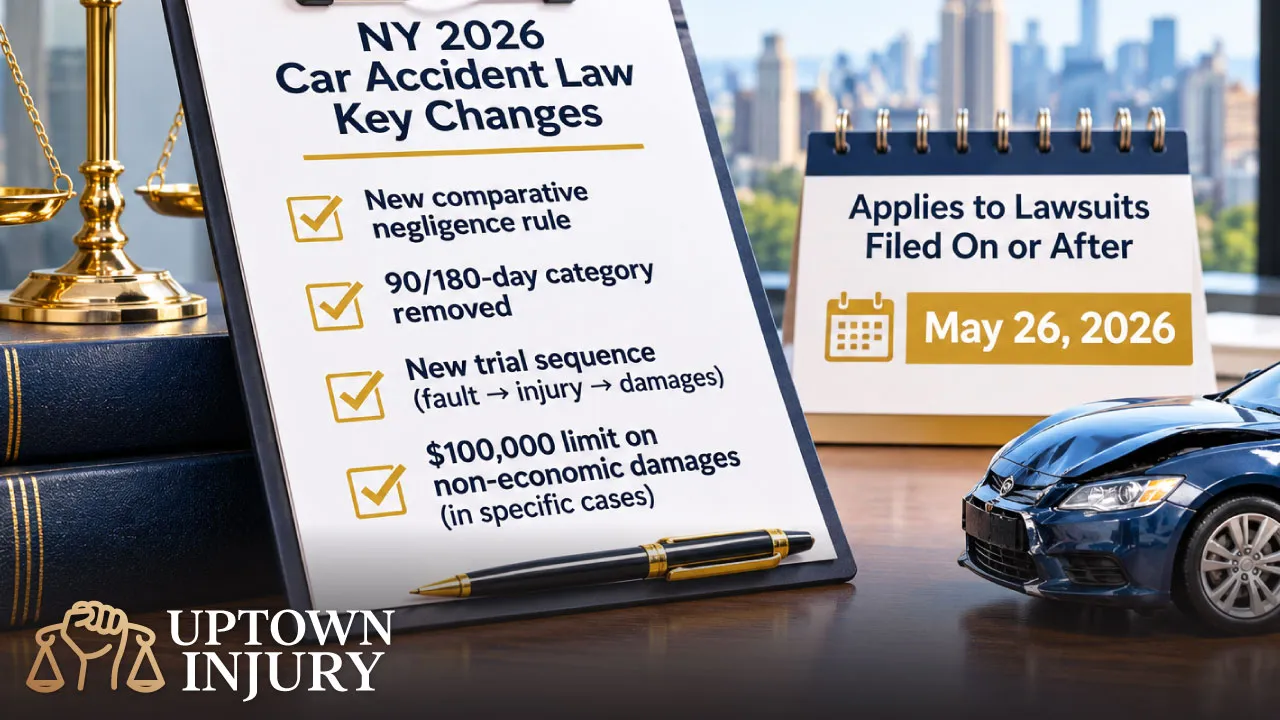
Moreover, under New York Insurance Law § 5104(d), an at-fault injured person who drove a vehicle they were legally subject to a $100,000 cap on non-economic damages. But a short lapse of less than 30 days exempts this cap on non-economic damages.
Similarly, if you were a passenger in another insured car, you can qualify for no-fault benefits under the applicable vehicle’s policy, even if your own auto policy had lapsed. If an uninsured driver injured you, you may qualify for benefits through a household family member’s policy or, in certain circumstances, the Motor Vehicle Accident Indemnification Corporation (MVAIC).
However, the consequences of a car insurance lapse can vary depending on how long your coverage remains inactive. Below is a comparison of short-term and longer-term lapses and how the 30-day threshold may affect you:
| Insurance Lapse | Potential Consequences |
|---|---|
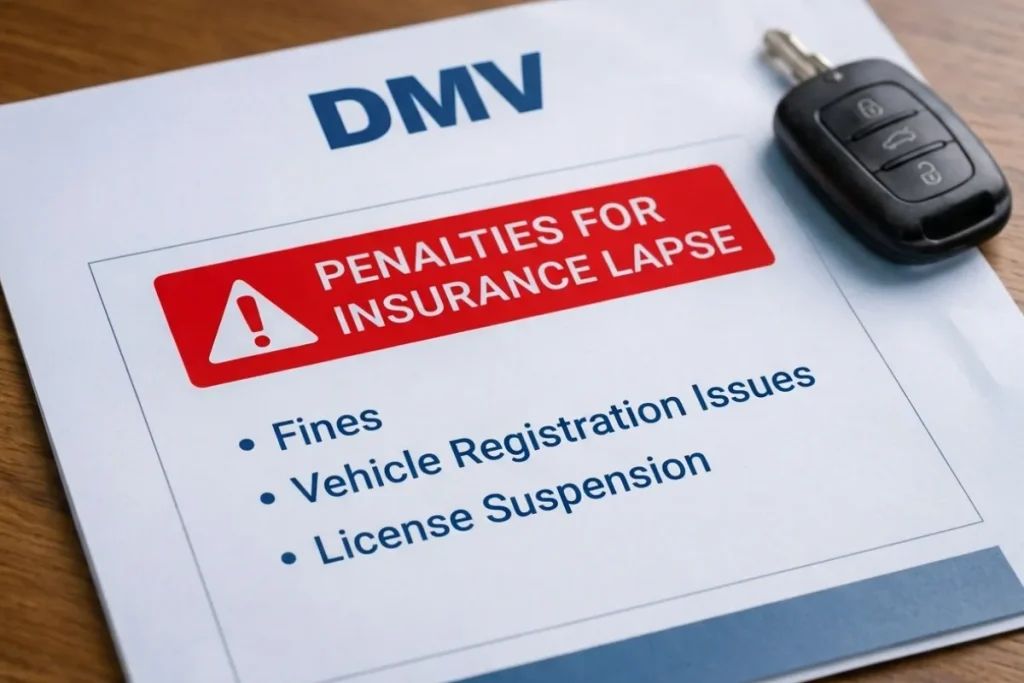
| 29-day lapse | The DMV may suspend your registration or impose a civil penalty of $8 per day ($232 total) if you are eligible. |
| 30-day lapse | The DMV may suspend your registration or impose a $240 civil penalty if you are eligible. |
| 31–90-day lapse | Higher daily civil penalties may apply, or the DMV may suspend your license and vehicle registration. |
| Over 90 days | Registration and driver’s license suspensions generally apply, and the civil penalty option is unavailable. |
What Is a 29-Day Car Insurance Lapse?
A 29-day car insurance lapse occurs when your auto insurance policy remains inactive for 29 consecutive days because of a late payment, policy cancellation, or failure to reinstate coverage. During this lapse period, you lack the required insurance coverage, which may affect your registration, driving privileges, and accident-related claims.
Here are the consequences of a 29-day lapse in coverage:
- Higher Premiums: When you apply for a new policy, the insurance company will view you as a higher-risk driver. Even a short lapse can cause your new insurance rates to increase by 8% to 15% or more.
- Loss of Loyalty Discounts: You will instantly lose any “continuous car insurance coverage” discounts you had built up with your previous insurer.
- Out-of-Pocket Liability: If you are caught driving during these 29 days and get into an accident, you’ll be responsible for all medical bills and property damage.
Is There a Grace Period for a Car Insurance Lapse?
No, New York does not provide a grace period that lets you legally drive without required auto insurance after your policy expires. Some insurers may offer a short payment grace period, but it depends on your policy and circumstances. However, an insurer must provide 15 days’ advance notice before canceling an auto insurance policy for non-payment under New York Insurance Law § 3425. This notice period does not give you automatic permission to drive without insurance.
How Long Does a Lapse Stay On Your Driving History?
In New York, an insurance lapse and its associated administrative actions remain visible on your standard driving record for three years from the end of the year in which the accident occurred. According to the NY DMV, non-criminal driving incidents and suspensions are displayed for three additional years. Auto insurers may also review your insurance history over the previous 3 to 5 years when assessing your risk profile, determining eligibility for certain policy tiers, and calculating premiums.
What Are the Most Common Reasons For a 29-Day Insurance Lapse?
A 29-day car insurance lapse often results from missed premium payments, expired automatic payment methods, or billing errors. Accident non-renewal and selling a vehicle without adjusting coverage can also cause a lapse. In New York, these issues can interrupt continuous auto insurance coverage and may lead to DMV penalties if the vehicle remains registered.
Here is how these reasons can lead to a 29-Day insurance lapse:
1. Missed Premium Payments
A payment may be overdue because you forgot the due date, had insufficient funds in your bank account, or failed to notice a payment reminder. If the insurer cancels your policy after you have complied with the applicable notice requirements, your vehicle will no longer have active insurance coverage. Therefore, it’s essential to review your billing statements and cancellation notice to determine when the insurer ended coverage.
2. Expired Credit or Debit Cards
An expired credit or debit card can prevent your auto insurance premium from being processed successfully. The same problem may occur if your bank declines a transaction, your account has insufficient funds, or your insurer has outdated payment information. When a payment fails, the insurer may send a notification requesting an updated payment method or an outstanding balance.
3. Confusion About Renewal Dates
Misunderstanding an insurance renewal date can leave drivers without continuous coverage. Some drivers assume their policy will renew automatically, while others believe they have additional time to pay a premium after the stated deadline.
However, automatic renewal and payment arrangements depend on the insurer’s procedures and the policy terms. A driver only discovers the problem when requesting an insurance identification card, renewing a vehicle registration, or attempting to file an accident claim.
4. Insurance Company Billing Errors
An insurance lapse may sometimes result from a billing or administrative error rather than a driver’s failure to pay. For example, an insurer may incorrectly record a payment, apply it to the wrong policy, or experience a processing delay.
Incorrect account information can also cause a payment to appear overdue even when the driver attempted to pay on time. These errors can become serious if the insurer records a cancellation and reports a coverage termination to the New York DMV.
5. Switching Insurance Providers
Changing auto insurance companies can result in a 29-day lapse if the existing policy ends before the replacement policy takes effect. This may happen if the new insurer delays issuing the policy, the driver misunderstands the effective date, or the previous policy is canceled too early.
For example, if your existing coverage ends on October 1 but your replacement policy does not begin until October 29, you may have a 29-day gap in coverage. During that period, you cannot rely on either policy to cover an accident unless other applicable coverage exists.
Can You Sue the At-Fault Driver if Your Car Insurance Lapsed?
Yes, you can generally sue the at-fault driver even if your car insurance lapsed, but New York law may limit the damages you can recover. Your eligibility depends on the accident circumstances, the type of damages claimed, and whether you meet the legal requirements for a lawsuit.
To recover compensation, you must prove that the other driver’s negligence caused the accident and your injuries. New York also follows a comparative negligence rule. If you share responsibility for the crash, your compensation may be reduced according to your percentage of fault.
Additionally, New York requires an injured person to meet the serious injury threshold under Insurance Law § 5102(d) to recover non-economic damages, such as pain and suffering, in a motor vehicle accident lawsuit.
Can the DMV Suspend Your License After a 29-Day Lapse?
No, in New York, the DMV cannot suspend your driver’s license for a 29-day insurance lapse, though it will suspend your vehicle’s registration if the lapse is not resolved. Driver’s license suspensions for insurance lapses only trigger if the uninsured period reaches 91 days or more.
Moreover, if you try to backdate insurance to cover an accident, it constitutes insurance fraud. Besides that, New York requires continuous coverage for registered vehicles, and a lapsed car coverage can trigger penalties even if you did not drive the vehicle during that period. For a 29-day lapse, you may face a daily fine of $8 per day for the first 30 days, totaling $232, to clear the penalty and avoid registration action.
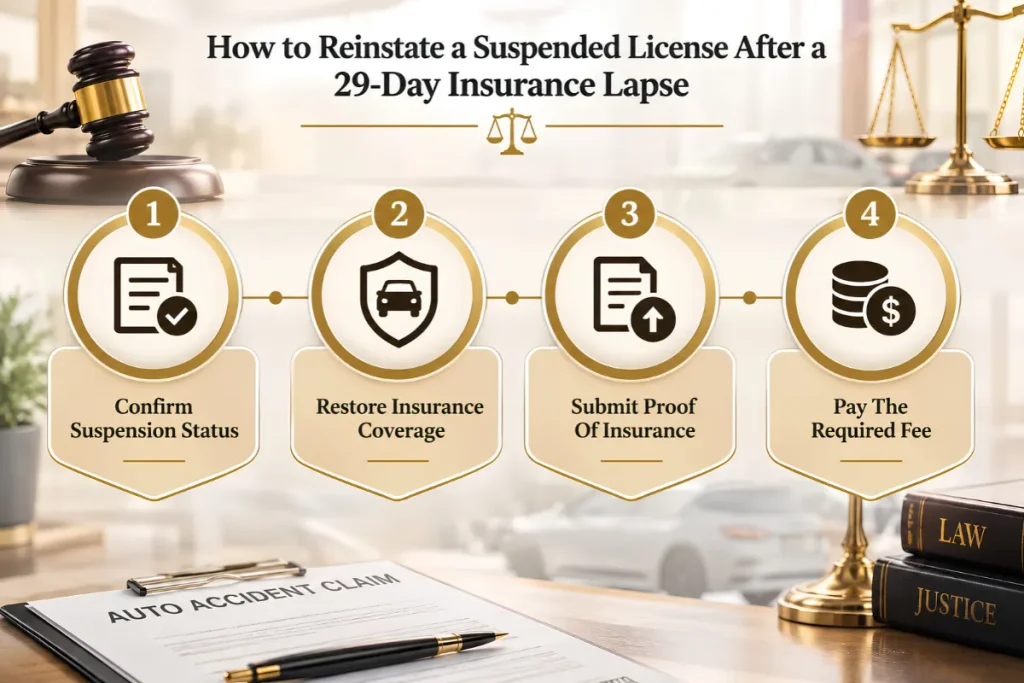
Can You Reinstate Auto Insurance After a 29-Day Lapse?
Yes, you can reinstate your auto insurance or obtain new coverage after a 29-day lapse, but you will still face penalties from the state agency. Before reinstating, ask your insurance company whether they allow reinstatement beyond the typical grace period, which is often 10 to 30 days.
You may have to pay any missed premiums and a reinstatement fee if the company agrees to restore your previous policy. However, if your old provider refuses to reinstate lapsed car insurance, you can buy a new policy from another carrier. Your new carrier must electronically file Form FS-1 with the DMV to verify that you have active coverage.
What Should You Do If Your Car Insurance Lapses?
If your car insurance coverage lapses, you should immediately stop driving and contact your insurance provider for a renewal reminder. You should also avoid driving until you confirm that you have valid coverage and arrange new insurance if necessary. This is because courts may view driving without insurance as negatively impacting credibility in claims.
If you drive without insurance, you have to pay a $750 civil penalty to the New York DMV to restore your revoked driver’s license. Therefore, surrender your license plates to the DMV if required to avoid registration suspension and civil penalties for an uninsured period. In addition, if your insurer cannot reinstate your policy, compare new policies and confirm the effective date before driving again.
Keep proof of coverage and verify your registration status with the New York DMV immediately to resolve any issues. Drivers with lapses may also need to file an SR-22 to remain insured because insurers might classify a 29-day lapse as a major risk factor for future premiums.
What Evidence Do You Need to Prove Your Claim After a Lapse?
To prove your claim after a car insurance lapse, gather the police report, accident scene photos, witness statements, medical records, repair estimates, and proof of lost wages. You should also obtain your insurance policy, cancellation notices, missed payment receipts, and coverage history documents to establish your coverage status and accident-related losses.
Here is how this evidence can help identify the at-fault party, document your financial losses, and clarify whether insurance coverage applied when the crash happened:
Police Report
A police report can document the accident date, location, parties involved, road conditions, and statements made at the scene. It may also identify witnesses and record traffic violations or the officer’s initial observations.
Accident Scene Photos and Videos
Photographs and videos can help show vehicle damage, skid marks, traffic signals, road conditions, visible injuries, and the positions of vehicles after the collision. Dashcam footage and nearby surveillance recordings may also establish how the crash occurred. Therefore, it’s essential to preserve original files and collect them promptly because some surveillance footage may be deleted.
Witness Statements
Statements from witnesses to the accident can help clarify how the collision occurred and whether the driver violated traffic rules. Collect witnesses’ names and contact information, along with their descriptions of what they observed. Independent witnesses are also useful when the drivers provide conflicting accounts of the crash.
Medical Records
Medical records connect your reported injuries to the accident and document the treatment you received. Keep emergency room reports, diagnostic imaging, doctors’ notes, prescriptions, physical therapy records, and follow-up evaluations.
Additionally, you must seek medical attention promptly and follow your provider’s recommendations. This is because unexplained treatment gaps may give an insurer grounds to question the extent or cause of your injuries.
Vehicle Repair Estimates and Damage Records
Repair estimates, invoices, photographs, and vehicle inspection reports can establish the extent of property damage and the likely cost of repairs. If your vehicle is declared a total loss, retain the valuation report and related insurance correspondence. These documents help substantiate your property damage claim and challenge inaccurate repair or valuation assessments.
Proof of Lost Wages
If your injuries prevent you from working, gather pay stubs, tax records, employer letters, attendance records, and documentation of missed workdays. If you’re self-employed, collect invoices, business records, and tax returns to prove lost income. Medical restrictions and employment records can further explain how the injury affected your ability to earn.
Insurance Policy and Coverage Documents
Your insurance policy, declarations page, cancellation notice, payment receipts, and reinstatement confirmation can help establish when coverage began or ended. These records are especially important after a lapse because the exact due dates and applicable policy terms may affect the benefits available. However, do not assume that paying a missed car insurance payment automatically restores coverage.
Insurance Correspondence and Claim Records
Keep copies of claim forms, emails, letters, adjuster statements, recorded-statement requests, and written coverage or denial decisions. These records can help establish what you reported, what the insurer requested, and why it accepted or disputed your claim. In addition, save communications from every insurer involved, including your own company and the other driver’s insurer.
When Should You Contact a Car Accident Attorney?
You should contact Uptown Injury Law, PLLC attorneys if insurers deny claims during any active coverage gap. You can also contact our car accident lawyers if the insurer incorrectly claims a lapse when you paid, or if the other driver’s insurer exploits the gap to pay zero.
In addition, you should contact us if medical bills exceed what you can pay. Moreover, before giving any statement to an adjuster, discuss your case with our lawyers for free. Here’s how our team can help you:
Policy Audit
Our attorney reviews your insurance policy, payment history, cancellation notices, and applicable grace-period provisions to determine when your coverage actually ended. We check whether the insurer followed the required cancellation procedures and whether any reinstatement terms apply. This review can help identify errors or circumstances that affect your coverage status at the time of the accident.
Proof of Payment
If you believe you paid your premium before the policy was canceled, we can request payment confirmations. We can also request bank statements, insurer transaction records, and written confirmation from the insurance company. These documents may help establish whether the payment was received, processed, or applied correctly.
Third-Party Fault
Even if your insurance lapsed, another driver’s negligence may still give you grounds to pursue a claim. An attorney investigates the accident, reviews the police report, gathers witness statements, and examines available evidence to establish fault. We can also identify other potentially responsible parties and applicable insurance policies.
Defense Protection
Our lawyers can protect your interests when insurers offer a settlement that may not cover your documented losses or challenge liability. We review settlement terms, explain potential financial consequences, and, when appropriate, respond to unsupported demands for payment. Reach out today and let us help you get liability coverage for your losses before your policy ends.
Can You Challenge an Insurance Company Denial After a Lapse?
Yes, you can challenge an insurance company’s denial if the insurer incorrectly applied its policy terms, miscalculated the cancellation date, or overlooked valid proof of payment. To challenge the denial, request a written denial letter that explains why the insurer rejected your claim. Review the coverage dates and reinstatement documents to determine whether the denial is justified.
You can also take the following steps to dispute the decision:
- Review the cancellation date: Check whether the insurer canceled your policy before the accident. Also, check whether coverage remained active under the applicable policy terms.
- Gather proof of payment: bank account statements, payment confirmations, receipts, and correspondence. This shows that you paid the premium or that the insurer reinstated your coverage.
- Dispute incorrect information: If the insurer relied on an inaccurate lapse period or overlooked relevant documents, submit a written appeal.
- Explore other compensation options: If your policy was inactive, you may still have a claim against the at-fault driver.
Did Your Insurance Lapse Before a Crash? Get Legal Guidance From Uptown Injury Law, PLLC!
If you have a 29-day lapse in your car insurance coverage, you may face denied insurance benefits, unexpected medical bills, and DMV penalties. A lapse can also lead to vehicle repossession if the vehicle is financed or leased. Even a short lapse can complicate your claim, making you uncertain about your financial responsibilities and legal rights.
At Uptown Injury Law, PLLC, we help injured accident victims address insurance complications and pursue multi-million-dollar settlements after a crash. Our team investigates third-party liability, identifies potentially applicable insurance policies, challenges questionable claim denials, and assesses recoverable damages. Visit us at 2417 Third Ave., Suite 505, Bronx, New York 10451, or call 917-540-8728 to discuss your injury claim.
FAQs
What If You Paid Your Premium but Insurance Still Lapsed?
If you paid your premium but your car insurance still lapsed in New York, contact your insurer immediately. Request written confirmation of your payment and coverage status. You should also review your bank records and cancellation notices to determine whether an administrative issue caused the lapse.
Does a 29-Day Insurance Lapse Affect a Pending Claim?
A 29-day insurance lapse in New York may affect a pending claim if the accident occurred after your coverage ended. However, the lapse does not automatically invalidate every claim. Your rights depend on the accident date, policy terms, applicable insurance laws, and whether another party bears responsibility.
How Long Do I Have to Restart My Car Insurance?
New York does not provide a universal grace period that allows every driver to restart car insurance after a lapse. However, some states allow exceptions for short lapses if preceded by a clean coverage history. In such cases, you should contact your insurer immediately, confirm whether reinstatement is available, and avoid driving.
What Should You Avoid Telling the Other Driver’s Insurer?
Avoid admitting fault, speculating about how the accident happened, and exaggerating injuries. You should also agree to a recorded statement before understanding your rights. Do not guess about your insurance status or sign a release without reviewing its consequences.
Can Police Stop You for an Insurance Coverage Gap?
Yes, police can stop a vehicle when they have a lawful basis to investigate a suspected violation, such as an uninsured vehicle. Operating an uninsured vehicle can result in misdemeanor citations or penalties. Since driving without insurance is illegal in the US, police may fine you up to $1,500.